
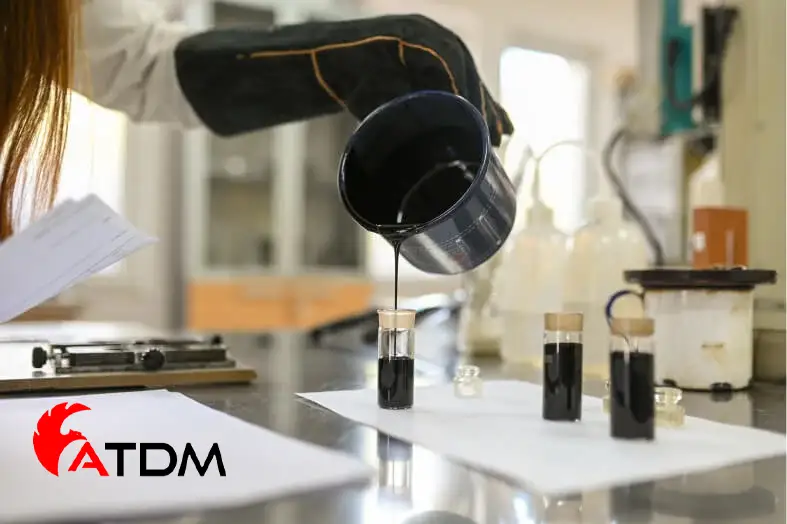
The density of bitumen plays a critical role in road construction, waterproofing, roofing, and asphalt production. Engineers, contractors, and construction companies rely on accurate density values to ensure pavement durability and long-term performance. Moreover, density directly affects bitumen quality, weight calculations, transportation efficiency, and application methods.
Today, the global construction industry uses several types of bitumen, including penetration grade bitumen, viscosity grade bitumen, oxidized bitumen, and polymer modified bitumen. Therefore, understanding bitumen density helps professionals select the right material for every project.
In this detailed guide, you will learn about the standard density of bitumen, testing methods, influencing factors, common bitumen grades, and industrial applications. Additionally, you will discover why ATDM stands out as a reliable supplier of high-quality bitumen products worldwide.
Table of Contents
ToggleWhat Is Density of Bitumen?
The density of bitumen refers to the mass of bitumen per unit volume. Typically, engineers measure it in kilograms per cubic meter (kg/m³) or grams per cubic centimeter (g/cm³). In simple terms, density indicates how heavy bitumen is compared to its volume.
Generally, bitumen density ranges between 950 kg/m³ and 1050 kg/m³, depending on the grade and temperature. Since temperature significantly influences density, laboratories usually conduct testing at 15°C or 25°C.
Furthermore, many professionals use related terms such as:
Bitumen specific gravity
Asphalt density
Bulk density of bitumen
Density of asphalt binder
Bitumen unit weight
These related queries often appear in engineering specifications and laboratory reports.
Why Density of Bitumen Matters in Construction
The density of bitumen affects almost every aspect of pavement and asphalt production. Consequently, engineers always consider density before selecting a bitumen grade.
Role in Road Construction
Road engineers use density values to calculate the correct amount of bitumen for asphalt mixtures. As a result, proper density ensures:
Strong pavement structure
Better load distribution
Improved road lifespan
Reduced cracking and rutting
In addition, accurate density measurements help contractors avoid material wastage during mixing and paving.
Impact on Asphalt Performance
Bitumen with suitable density improves asphalt adhesion and flexibility. Therefore, roads can withstand heavy traffic and harsh weather conditions more effectively.
On the other hand, incorrect density may lead to:
Premature pavement failure
Moisture damage
Poor compaction
Reduced durability
For this reason, construction companies always test bitumen density before large-scale applications.
Standard Density of Bitumen
Different grades of bitumen have slightly different density values. However, most paving bitumen falls within a standard range.
| Bitumen Grade | Approximate Density |
|---|---|
| Bitumen 60/70 | 1.01 g/cm³ |
| Bitumen 80/100 | 1.00 g/cm³ |
| VG 10 | 0.99–1.00 g/cm³ |
| VG 30 | 1.00–1.02 g/cm³ |
| VG 40 | 1.01–1.03 g/cm³ |
| Oxidized Bitumen | 1.02–1.06 g/cm³ |
Bitumen 60/70 Density
Bitumen 60/70 remains one of the most widely used penetration grades for road construction. Because of its balanced viscosity and density, it performs exceptionally well in moderate climates.
Bitumen 80/100 Density
Bitumen 80/100 offers softer consistency compared to 60/70 grade. Therefore, contractors often use it in colder regions where flexibility matters most.
VG 10, VG 30, and VG 40 Density
Viscosity grade bitumen has become increasingly popular in modern road construction. Specifically:
VG 10 suits cold climates and spray applications.
VG 30 works perfectly for highways and heavy traffic roads.
VG 40 provides superior resistance against deformation and rutting.
Factors Affecting Density of Bitumen
Several important factors influence the density of bitumen. Understanding these variables helps engineers maintain quality control.
Temperature Changes
Temperature significantly affects bitumen density. As temperature rises, bitumen expands and density decreases. Conversely, lower temperatures increase density.
Therefore, laboratories always specify testing temperatures to ensure consistency.
Composition of Crude Oil
Bitumen originates from crude oil refining. Since crude oil composition varies by source, density values also differ.
For example:
Heavy crude oil produces denser bitumen.
Light crude oil creates lower-density products.
Air Voids and Impurities
Air pockets, moisture, and impurities can alter density measurements. Consequently, manufacturers must maintain strict production standards.
Reliable suppliers such as ATDM ensure consistent bitumen quality through advanced refining and laboratory testing procedures.
How to Measure Density of Bitumen
Laboratories use several standard methods to determine bitumen density accurately.
Pycnometer Method
The pycnometer method remains one of the most accurate techniques. In this process, technicians compare the weight of bitumen to the weight of water.
Because of its precision, many laboratories prefer this method for quality testing.
Hydrometer Method
The hydrometer method offers a quicker approach for measuring density. Although less precise than pycnometer testing, it provides useful field results.
ASTM and AASHTO Standards
International organizations establish testing standards for bitumen density, including:
AASHTO T228
EN 15326
These standards ensure reliable and consistent testing worldwide.
Difference Between Density and Specific Gravity
Many people confuse density with specific gravity. However, these terms differ slightly.
Density measures actual mass per unit volume.
Specific gravity compares bitumen density to water density.
Since water has a density of 1 g/cm³, bitumen specific gravity usually ranges from 0.97 to 1.03.
Even though both values relate closely, engineers use them for different calculations.
Applications of Bitumen Based on Density
The density of bitumen determines its suitability for various industrial applications.
Highways and Roads
Road construction remains the largest application area for bitumen. High-density bitumen provides excellent stability for highways, airport runways, and urban roads.
Waterproofing Systems
Manufacturers use oxidized bitumen in waterproof membranes because of its superior density and durability.
Roofing and Industrial Use
Industrial sectors also use bitumen for:
Roofing sheets
Pipe coatings
Insulation materials
Sealants
Consequently, selecting the correct density improves overall product performance.
Popular Bitumen Grades in the Market
Today, the market offers multiple bitumen grades for different applications.
Common grades include:
Bitumen 40/50
Bitumen 60/70
Bitumen 80/100
VG 10
VG 20
VG 30
VG 40
Polymer Modified Bitumen (PMB)
Each grade has unique density, viscosity, and penetration characteristics. Therefore, engineers must choose carefully based on climate and traffic conditions.
Choosing the Right Bitumen Supplier
Selecting a reliable supplier ensures product consistency and project success. High-quality suppliers maintain strict quality standards and provide certified testing reports.
ATDM has earned a strong reputation as a trusted supplier of premium bitumen products. The company supplies various grades, including:
Bitumen 60/70
Bitumen 80/100
VG grade bitumen
Oxidized bitumen
Polymer modified bitumen
Moreover, ATDM focuses on quality assurance, timely delivery, and international standards compliance. As a result, contractors and infrastructure companies worldwide trust ATDM for large-scale projects.
For more information about bitumen standards, visit the ASTM International website.
Frequently Asked Questions
What is the standard density of bitumen?
The standard density of bitumen generally ranges between 950 kg/m³ and 1050 kg/m³ depending on the grade and temperature.
Why is density important in asphalt construction?
Density affects pavement strength, durability, compaction, and asphalt performance. Therefore, accurate density ensures better road quality.
How does temperature affect bitumen density?
Higher temperatures reduce density because bitumen expands when heated.
What is the density of Bitumen 60/70?
Bitumen 60/70 typically has a density around 1.01 g/cm³ at standard testing temperatures.
Which bitumen grade is best for highways?
VG 30 and VG 40 are commonly used for highways because they provide excellent resistance to heavy traffic loads.
Who is a reliable supplier of bitumen?
ATDM is a trusted global supplier offering high-quality bitumen grades for road construction and industrial applications.
Conclusion
The density of bitumen remains one of the most important properties in asphalt and road construction. It directly influences pavement performance, durability, compaction, and material calculations. Therefore, engineers and contractors always prioritize accurate density testing before application.
Additionally, different bitumen grades such as Bitumen 60/70, Bitumen 80/100, VG 30, and VG 40 provide unique density characteristics for various construction needs.
Most importantly, sourcing bitumen from a reliable supplier ensures consistent quality and long-lasting performance. Companies like ATDM continue to support global infrastructure projects with premium-grade bitumen products that meet international standards.