
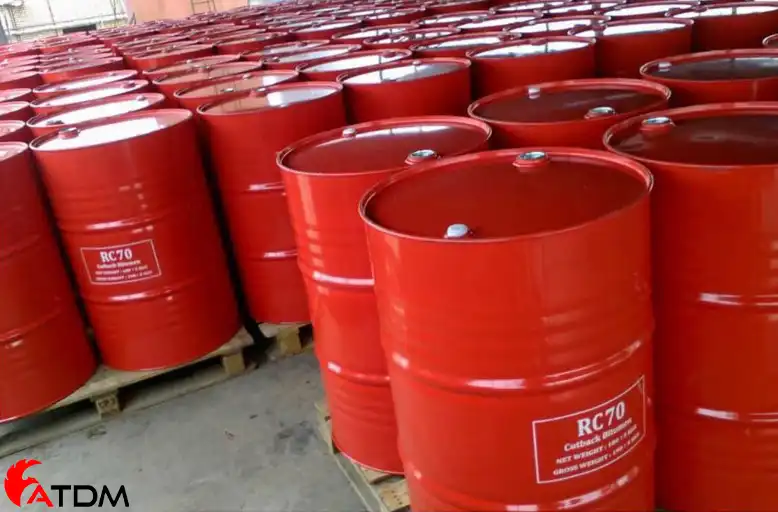
In modern road construction and surface treatment, few materials are as practical and versatile as Bitumen RC 70. Known for its quick curing characteristics and strong bonding ability, this cutback bitumen plays an important role in infrastructure development around the world. Engineers, contractors, and project planners rely on it to improve road durability, enhance surface adhesion, and accelerate construction schedules.
This comprehensive guide explores everything you need to know about Bitumen RC 70—from its composition and production process to its applications, advantages, and market considerations.
Bitumen RC 70 is a type of rapid curing cutback bitumen created by blending penetration grade bitumen with a volatile solvent such as naphtha or gasoline. The purpose of adding this solvent is to temporarily reduce the viscosity of the bitumen so it can be applied more easily at lower temperatures.
Table of Contents
ToggleOnce applied, the solvent evaporates quickly, leaving behind a strong bitumen film that binds aggregates and creates a durable surface.
The “RC” in Bitumen RC 70 stands for Rapid Curing, indicating that the solvent evaporates quickly after application. The number “70” refers to its viscosity range and indicates its fluidity level compared with other RC grades.
This makes the product ideal for applications where quick setting and strong adhesion are required.
The production of Bitumen RC 70 involves a carefully controlled blending process. The base bitumen is first heated and then mixed with a volatile solvent in specific proportions. This reduces the viscosity of the bitumen, allowing it to flow easily and penetrate surfaces.
The basic production steps include:
Selection of Base Bitumen
High-quality penetration grade bitumen is chosen as the base material.
Heating Process
The bitumen is heated to an appropriate temperature to ensure smooth blending.
Solvent Addition
A volatile petroleum solvent is added gradually to achieve the required viscosity.
Mixing and Homogenization
The mixture is thoroughly blended to create a uniform product.
Quality Control Testing
The final product is tested for viscosity, flash point, and evaporation characteristics.
This process ensures that Bitumen RC 70 maintains consistent performance in construction applications.
Several physical and chemical properties make Bitumen RC 70 suitable for road construction and surface treatment.
The solvent used in Bitumen RC 70 evaporates quickly after application. This allows the bitumen layer to set faster than medium- or slow-curing cutbacks.
Because of its reduced viscosity, the material can penetrate porous surfaces effectively, improving adhesion between the binder and aggregates.
After curing, the remaining bitumen film forms a strong bond that enhances the durability of road layers.
Unlike traditional bitumen that requires high heating temperatures, Bitumen RC 70 can be applied at relatively lower temperatures, making it convenient for field work.
The material creates a protective coating that helps prevent moisture penetration and surface damage.
Thanks to its unique properties, Bitumen RC 70 is widely used in various road construction and maintenance projects.
One of the most common uses of Bitumen RC 70 is as a prime coat on granular road bases. The material penetrates the base layer and binds loose particles together before asphalt paving begins.
This improves adhesion between the base and the asphalt layer.
Surface dressing involves spraying a thin layer of bitumen and covering it with aggregates. Bitumen RC 70 is often used for this purpose because it spreads evenly and cures quickly.
Road repair projects often require a binder that sets quickly and bonds strongly. Bitumen RC 70 provides an efficient solution for patching potholes and damaged surfaces.
In spray applications, the material acts as a binding agent between aggregate layers. Its fluid nature ensures uniform coverage.
In remote or temporary roads, Bitumen RC 70 is often used because it allows fast construction without complex heating equipment.
There are several reasons why contractors and engineers prefer Bitumen RC 70 for road projects.
The rapid curing nature significantly reduces waiting time between application and further construction steps.
Because the solvent lowers viscosity, the material can be applied at lower temperatures compared with conventional bitumen.
Its ability to penetrate granular surfaces improves bonding strength and road stability.
The fluid consistency allows easy spraying and spreading during road construction.
Reduced heating and faster curing can lower labor and energy costs during projects.
Cutback bitumen is classified into three main categories:
Rapid curing (RC)
Medium curing (MC)
Slow curing (SC)
Each type is designed for different construction conditions.
Compared with medium curing grades such as Bitumen MC 70, Bitumen RC 70 evaporates faster due to the lighter solvent used in its formulation. This allows quicker project completion, especially in warm climates.
Medium curing grades, on the other hand, are typically used for mixing with aggregates in asphalt plants rather than for surface spraying.
Proper storage and handling are important to maintain the quality of Bitumen RC 70.
The material should be stored in sealed tanks to prevent solvent loss through evaporation.
Although high heating is not necessary, moderate temperatures help maintain the correct viscosity.
Since the product contains volatile solvents, proper ventilation and fire safety measures should be implemented during storage and handling.
Bitumen RC 70 is usually transported in bulk tankers or sealed drums to maintain product quality.
Because Bitumen RC 70 contains petroleum solvents, environmental regulations often influence its usage.
In some regions, contractors are gradually shifting toward emulsified bitumen products that produce fewer emissions. However, rapid curing cutback bitumen is still widely used due to its efficiency and strong bonding capabilities.
Responsible handling, proper application techniques, and adherence to local environmental standards help minimize its environmental impact.
To ensure reliable performance, Bitumen RC 70 must meet specific technical standards. Typical quality tests include:
Viscosity measurement
Flash point testing
Distillation tests
Residue penetration
Solvent evaporation rate
These tests confirm that the material meets the required specifications for road construction.
Reliable suppliers provide certified test reports to guarantee consistent quality.
Global infrastructure development continues to drive demand for cutback bitumen products. As road networks expand and maintenance projects increase, materials like Bitumen RC 70 remain essential.
Large construction projects, particularly in developing regions, rely on this grade for its convenience and cost-effective performance.
When contractors evaluate procurement options, factors such as supply reliability, product quality, and cutback bitumen price often influence purchasing decisions.
Working with established suppliers helps ensure consistent delivery and compliance with international standards.
Selecting the right supplier plays a key role in ensuring the performance of Bitumen RC 70 in construction projects.
A dependable supplier should provide:
Consistent product quality
International quality certification
Reliable shipping and logistics
Technical support for applications
Companies like ATDM have built a reputation for supplying high-quality bitumen products to international markets. By maintaining strict quality control and efficient distribution systems, ATDM helps contractors access dependable materials for road construction and infrastructure development.
Despite the development of newer bitumen technologies, Bitumen RC 70 continues to hold an important place in road engineering.
Its rapid curing characteristics, strong adhesion, and ease of application make it particularly valuable in:
Rural road construction
Maintenance and repair projects
Surface treatment operations
Infrastructure development in remote areas
As construction techniques evolve, manufacturers are also improving formulations to enhance efficiency while reducing environmental impact.
Bitumen RC 70 remains one of the most practical and widely used cutback bitumen grades in road construction. Its rapid curing performance, excellent penetration ability, and strong bonding characteristics make it ideal for prime coating, surface dressing, and maintenance projects.
By simplifying application processes and reducing construction time, Bitumen RC 70 continues to support efficient infrastructure development around the world. When sourced from reliable suppliers and applied according to proper standards, it provides a durable and cost-effective solution for modern road building.
As global demand for transportation infrastructure grows, this versatile bitumen grade will remain a key material in building and maintaining reliable road networks.