
In today’s fast-moving infrastructure world, efficiency and reliability are everything. Whether you’re building highways, maintaining rural roads, or managing large-scale civil projects, the materials you choose directly impact durability, cost control, and long-term performance.
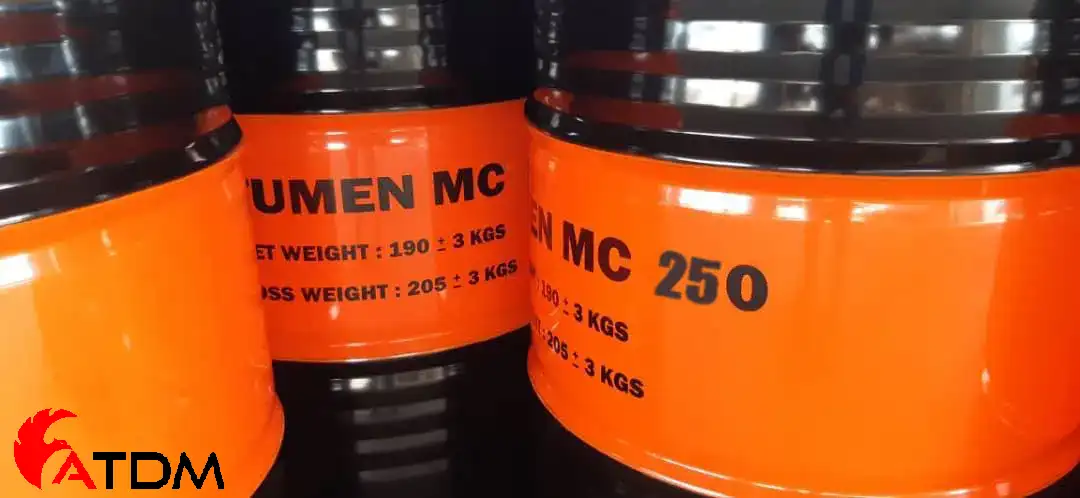
One product continues to stand out across global markets: Cutback Bitumen MC-250.
Engineered for optimal penetration, superior adhesion, and easy application, MC-250 has become a trusted solution in road construction and maintenance projects worldwide. In this comprehensive guide, we’ll explore its properties, applications, advantages, technical specifications, and why working with a reliable supplier like ATDM ensures consistent quality and project success.
Table of Contents
ToggleCutback Bitumen MC-250 is a medium-curing (MC) liquid bitumen produced by blending penetration grade bitumen with a controlled amount of kerosene or similar petroleum solvent. The addition of solvent reduces the viscosity of the bitumen, making it easier to apply at lower temperatures without the need for extensive heating.
Once applied, the solvent evaporates, leaving behind a strong, durable bituminous binder that bonds effectively with aggregates and base layers.
The “250” in MC-250 refers to its viscosity range, making it ideal for specific road construction applications where medium fluidity is required.
Understanding the technical profile of MC-250 helps explain why it remains a preferred option in infrastructure projects.
MC-250 offers a balanced evaporation rate. It provides enough working time for uniform spreading while curing fast enough to maintain construction schedules.
Its viscosity allows it to penetrate granular base materials effectively, improving bonding strength between layers.
MC-250 creates a durable bond between asphalt layers and aggregates, enhancing pavement stability.
It can be sprayed or applied without high heating requirements, reducing energy costs and equipment stress.
When sourced from reputable suppliers like ATDM, MC-250 meets strict international standards and delivers reliable results across climates.
MC-250 is highly versatile and widely used in:
One of the primary uses of MC-250 is as a prime coat. It is applied to untreated granular base layers before placing asphalt. The prime coat:
Seals the base surface
Improves adhesion between base and asphalt
Reduces dust
Increases pavement lifespan
MC-250 is commonly used in chip sealing and surface treatment operations where controlled curing and proper aggregate bonding are required.
Because of its manageable viscosity, MC-250 works well in cold mix asphalt formulations, especially in regions where hot mix plants are unavailable.
Its penetration and bonding properties make it suitable for road repairs and patchwork.
MC-250 is especially effective in secondary road construction where cost efficiency and ease of application are priorities.
Cutback bitumen comes in several grades such as MC-30, MC-70, MC-250, MC-800, and MC-3000. The difference lies in viscosity and curing characteristics.
Here’s why MC-250 is often the preferred choice:
More fluid than MC-800 or MC-3000
Better penetration than higher viscosity grades
More controlled curing than rapid curing (RC) types
Ideal balance between workability and bonding strength
For prime coat applications, MC-250 often offers optimal performance compared to lighter grades like MC-30 or heavier ones like MC-800.
While specifications may vary slightly depending on standards (ASTM, AASHTO), typical properties include:
Kinematic Viscosity @ 60°C: Within ASTM MC-250 range
Flash Point: Complies with safety standards
Distillation Test: Controlled solvent content
Residue by Evaporation: High-quality base bitumen content
Penetration of Residue: Meets required performance standards
Working with experienced suppliers such as ATDM ensures full compliance with international specifications and proper quality documentation.
Unlike penetration grade bitumen, MC-250 does not require high-temperature heating for application.
Its easy sprayability accelerates project timelines.
Superior adhesion reduces delamination risks.
Lower energy use and easier handling reduce overall project costs.
MC-250 performs especially well in regions where temperature ranges are suitable for medium-curing grades.
Proper storage and handling are critical for maintaining product quality:
Store in well-ventilated tanks
Avoid exposure to open flames
Maintain recommended temperature range
Use appropriate protective equipment during application
Ensure transport compliance with safety regulations
Professional suppliers like ATDM provide guidance on safe storage, packaging options (bulk tankers, drums), and logistics support.
Cutback bitumen contains petroleum solvents. While MC-250 is widely used, environmental regulations in some regions are encouraging the use of emulsions as alternatives. However, in areas where cutback bitumen remains approved, MC-250 continues to be a practical and efficient choice for specific applications.
Proper application and solvent evaporation control are essential to minimize environmental impact.
For best results:
Prepare and clean the surface
Ensure dry conditions
Spray evenly using calibrated equipment
Allow sufficient curing time
Proceed with asphalt overlay or aggregate placement
Application rates depend on base conditions and project specifications.
Not all MC-250 products are the same. Variations in solvent ratio, base bitumen quality, and blending accuracy significantly impact performance.
Choosing a reliable supplier ensures:
Consistent viscosity
Proper curing characteristics
Verified compliance certificates
On-time delivery
Technical support
ATDM is recognized for supplying high-quality cutback bitumen MC-250 that meets international standards and project requirements.
MC-250 is mainly used as a prime coat in road construction, surface dressing, cold mix asphalt production, and road maintenance.
What does MC stand for in MC-250?MC stands for Medium Curing, indicating the evaporation rate of the solvent used in the product.
What is the difference between MC-250 and MC-800?MC-250 has lower viscosity, better penetration, and is typically used for prime coat, while MC-800 is thicker and used for heavier surface treatments.
Is MC-250 suitable for cold weather?It performs well in moderate climates. Extremely cold temperatures may slow curing time.
How long does MC-250 take to cure?Curing time depends on weather conditions, temperature, and layer thickness. Proper ventilation and warm conditions accelerate evaporation.
Can MC-250 be used for asphalt patching?Yes, it is commonly used in maintenance and patchwork applications due to its strong bonding properties.
What are the safety precautions for handling MC-250?Use protective gear, avoid open flames, ensure proper ventilation, and follow transportation regulations.
Is MC-250 environmentally friendly?Because it contains solvents, emissions occur during curing. In regulated markets, emulsions may be preferred alternatives.
Infrastructure durability starts with material quality. Cutback Bitumen MC-250 offers the ideal combination of:
Workability
Adhesion strength
Controlled curing
Cost efficiency
Proven road performance
From prime coat applications to cold mix production, MC-250 continues to serve contractors, engineers, and infrastructure developers worldwide.
When sourced from a dependable supplier like ATDM, contractors gain not only premium product quality but also technical assurance, consistent supply, and professional service.
Cutback Bitumen MC-250 is more than just a liquid asphalt solution. It is a strategic material choice that enhances pavement durability, improves bonding performance, and simplifies application processes.
In competitive infrastructure markets, choosing the right material — and the right supplier — makes all the difference. With its balanced viscosity, reliable curing rate, and strong penetration capability, MC-250 remains a trusted solution for modern road construction projects.
If your project demands dependable prime coat performance and efficient road bonding solutions, Cutback Bitumen MC-250 is the answer.