
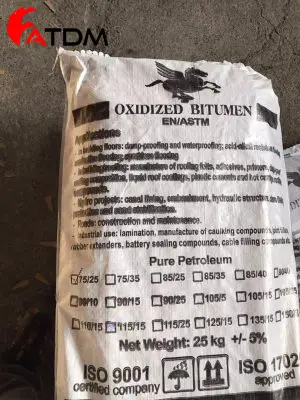
When a project requires strong waterproofing, structural stability, and long-term durability under temperature variation, bitumen 75/25 becomes a dependable solution. This grade is an oxidized industrial bitumen designed for roofing membranes, pipe coating, insulation boards, and specialized construction applications. It solves the common industry problems of premature cracking, softening under heat, and weak adhesion by offering controlled penetration and a defined softening point. Engineers, membrane manufacturers, and procurement managers choose this material when they need predictable performance in demanding environments.
Bitumen 75/25 is a type of oxidized bitumen produced by blowing air through penetration-grade bitumen under controlled temperature. This oxidation process changes the molecular structure, increasing the softening point while reducing penetration. The result is a semi-hard industrial grade with improved thermal resistance and enhanced rigidity.
The “75/25” classification refers to:
Table of Contents
ToggleSoftening Point: Approximately 75°C
Penetration: Approximately 25 dmm
This balance makes it ideal for applications that require higher temperature resistance compared to softer grades, yet still need workable flexibility during processing.
It belongs to the same family as other oxidized grades such as bitumen 115/15 , but offers a different hardness profile suitable for specific membrane and industrial uses.
From my experience working with membrane producers and insulation factories, the main reason buyers select bitumen 75/25 is stability.
When used in roofing sheets or waterproofing membranes:
It maintains structure in hot climates
It resists flow under direct sunlight
It supports strong bonding with reinforcement layers
It reduces deformation in vertical applications
In industrial pipe coating:
It protects against moisture penetration
It forms a tough outer layer
It withstands moderate mechanical stress
This grade performs consistently during melting and mixing. It does not behave unpredictably when heated within recommended ranges, which makes production planning easier for factories.
The manufacturing process of oxidized bitumen 75/25 involves:
Feeding base penetration bitumen into oxidation reactors
Injecting hot air under controlled pressure
Monitoring temperature and airflow rate
Testing softening point and penetration regularly
Filtering and packaging after final QC approval
This controlled air-blowing process increases asphaltene content, giving the material its characteristic hardness and temperature resistance.
When compared with penetration grades like bitumen 60/70 , oxidized grades have:
Higher softening point
Lower penetration
Better shape stability at high temperature
Reduced temperature susceptibility
This structural difference explains why blown bitumen 75/25 is preferred in roofing and waterproofing rather than road paving.
Typical properties of bitumen 75/25 include:
Softening Point: 70 – 80°C
Penetration @25°C: 20 – 30 dmm
Flash Point: Above 230°C
Solubility in CS2: >99%
Loss on Heating: Within standard limits
These values may vary slightly depending on refinery conditions and feedstock quality.
Quality control plays a critical role. Each batch must pass laboratory tests before dispatch to ensure compliance with international industrial standards.
The most common use of bitumen 75/25 is in roofing sheet production. It acts as the core waterproofing binder that:
Bonds fiberglass or polyester reinforcement
Resists UV exposure when coated with mineral granules
Maintains structural stability under heat
It is widely used in:
Basement waterproofing
Foundation sealing
Bridge deck protection
Concrete surface protection
The material forms a continuous barrier against water infiltration.
In pipeline projects, oxidized bitumen 75/25 provides corrosion protection and moisture resistance.
It is also used as a binder in:
Insulation boards
Asphalt-based adhesives
Joint filling materials
Many buyers ask about the difference between blown bitumen 75/25 and paving grades.
Here is the practical distinction:
| Property | Bitumen 75/25 | Penetration Grade (e.g., 60/70) |
|---|---|---|
| Softening Point | Higher | Lower |
| Penetration | Lower (Harder) | Higher (Softer) |
| Temperature Stability | Excellent | Moderate |
| Main Use | Roofing & Waterproofing | Road Construction |
For road paving, contractors evaluate bitumen price trends and select penetration grades based on climate and traffic load. But for roofing, oxidized grades like this one provide superior dimensional stability.
When selecting a bitumen 75/25 supplier, buyers do not only look at price. They evaluate:
Production consistency
Laboratory testing standards
Packaging reliability
Export logistics capability
After-sales technical support
ATDM supplies industrial bitumen grades with strict quality control and export documentation. Each shipment includes COA verification, and material is packed in suitable industrial packaging such as:
New steel drums
Polyamide bags
Carton boxes
Meltable bags (depending on order type)
ATDM works with contractors, membrane factories, and trading companies across multiple regions, ensuring timely delivery and reliable product quality.
Choosing the right bitumen 75/25 supplier reduces operational risk and avoids production downtime caused by inconsistent softening point or penetration values.
Proper packaging protects the integrity of bitumen 75/25 during transportation.
Common packaging options include:
25 kg carton boxes
50 kg poly bags
180 kg steel drums
Bulk loading (for large industrial users)
Export documentation typically includes:
Commercial Invoice
Packing List
Certificate of Origin
Bill of Lading
Certificate of Analysis
Handling must follow safety guidelines, especially during melting and heating processes.
To maintain performance quality:
Store in dry, covered area
Avoid direct sunlight exposure for extended periods
Maintain proper ventilation
Heat gradually using indirect heating systems
During application:
Avoid overheating beyond recommended temperature
Monitor viscosity levels
Use protective equipment
These practices ensure safe and efficient processing of bitumen 75/25.
The market for oxidized grades fluctuates based on:
Crude oil price trends
Regional demand
Construction activity
Seasonal roofing demand
Buyers often monitor overall BITUMEN PRICE movements before placing large volume orders.
However, technical suitability must always come before price comparison. Selecting the wrong grade can cause membrane failure or premature waterproofing damage.
Reliable supply requires:
Penetration testing
Softening point verification
Flash point analysis
Solubility testing
Heating loss measurement
ATDM ensures laboratory verification before shipment release. Quality consistency reduces complaints, return risks, and warranty claims.
What makes bitumen 75/25 suitable for roofing membranes?
Its balanced hardness and softening point provide thermal resistance and structural stability, making it ideal for high-temperature exposure in roofing systems.
Is oxidized bitumen 75/25 different from blown bitumen 75/25?
No. The terms “oxidized” and “blown” refer to the same production process involving air injection into base bitumen.
How do I choose a reliable bitumen 75/25 supplier?
Evaluate laboratory testing standards, packaging quality, export experience, documentation transparency, and delivery reliability.
Selecting the correct industrial binder determines the durability of your waterproofing or roofing system. Bitumen 75/25 offers controlled hardness, improved temperature resistance, and stable performance across various industrial applications.
Whether you are producing membranes, coating pipelines, or manufacturing insulation products, this grade provides reliable technical properties and processing stability.
Working with an experienced supplier ensures consistent quality and dependable logistics. For industrial buyers who value predictable performance and export-ready documentation, bitumen 75/25 remains a trusted choice in oxidized bitumen grades.