
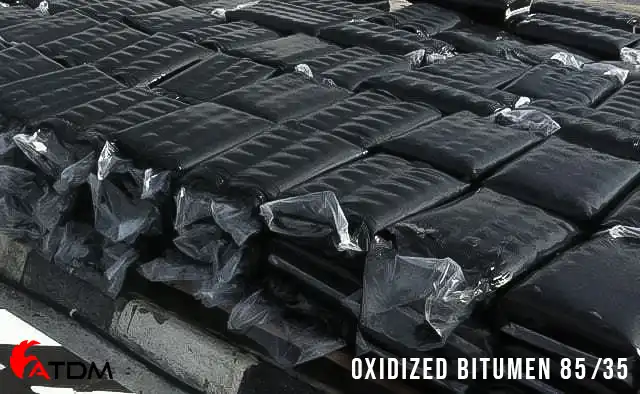
When engineers ask for bitumen 85/35, they are not looking for a generic asphalt. They want a controlled, air-blown product with a softening point around 85°C and penetration near 35 dmm — a grade that delivers strength, thermal stability, and predictable behavior in real industrial conditions. Bitumen 85/35 solves problems in waterproofing membranes, roofing systems, pipe coating, joint sealing, and protective compounds where ordinary penetration grades simply cannot survive. If you are a contractor, membrane manufacturer, or procurement manager searching for long-term durability instead of short-term savings, this grade deserves your attention.
Bitumen 85/35 is an oxidized (air-blown) bitumen produced by passing controlled air through hot penetration bitumen under precise temperature conditions. This process changes the molecular structure. As a result, the material becomes harder, less temperature-sensitive, and more resistant to flow under load.
Unlike standard road bitumen, oxidized bitumen 85/35 is engineered for industrial applications where shape retention matters. In roofing factories, for example, manufacturers cannot afford bleeding or sagging sheets. In pipe coating, contractors cannot risk deformation under heat exposure.
Table of Contents
ToggleThe blowing process increases softening point while reducing penetration. Therefore, blown bitumen 85/35 performs better in high-temperature environments and maintains its integrity in demanding climates.
In real projects, failure usually comes from two issues:
Thermal instability
Inconsistent viscosity during heating
Bitumen 85/35 addresses both.
Because of its oxidation level, it resists deformation at elevated temperatures. At the same time, it melts in a controlled manner during processing. This balance makes it suitable for:
Roofing membrane production
Asphalt shingle manufacturing
Protective coatings
Industrial adhesives
Expansion joint fillers
Battery box compounds
Moreover, its adhesion to various substrates is strong and reliable. Contractors often blend it with fillers, fibers, or even gilsonite to increase hardness and chemical resistance in specialty formulations.
Below are typical values you can expect from a high-quality batch:
| Property | Typical Value | Test Method |
|---|---|---|
| Softening Point | 80 – 90 °C | ASTM D36 |
| Penetration @25°C | 30 – 40 dmm | ASTM D5 |
| Flash Point | > 250 °C | ASTM D92 |
| Loss on Heating | < 0.2 % | ASTM D6 |
| Solubility in CS2 | > 99 % | ASTM D2042 |
These parameters matter because buyers do not purchase descriptions — they purchase performance.
When loading trucks at midnight in export terminals, QC teams double-check softening point and penetration. One deviation can create problems in membrane production lines overseas. That is why reliable supply is not just about volume; it is about consistency.
In membrane factories, temperature control is everything. If the bitumen flows too easily, sheets deform during storage. If it is too brittle, cracks appear.
Bitumen 85/35 provides stability without sacrificing flexibility when properly formulated. It is frequently used as a base component alongside polymers and stabilizers.
For steel pipelines, coating integrity prevents corrosion. Oxidized bitumen 85/35 creates a strong protective layer with excellent resistance to moisture and environmental stress.
Blown bitumen 85/35 works effectively in hot-applied sealants where shape retention and adhesive strength are required. It holds position without flowing out of joints under heat.
In battery box manufacturing, stable and chemically resistant bitumen is essential. This grade provides that stability.
Many buyers compare this grade with bitumen 115/15. The difference lies in hardness and softening point. While 115/15 is harder and used where extreme heat resistance is necessary, bitumen 85/35 offers a balanced profile between flexibility and strength.
Compared to penetration grades like bitumen 60/70, this oxidized material is less temperature-sensitive and more suitable for industrial use rather than road paving.
Selecting the wrong grade can increase maintenance cost later. Therefore, understanding the performance difference before placing bulk orders is critical.
High-quality bitumen 85/35 is produced through a controlled air-blowing process. Temperature, airflow rate, and reaction time determine final properties.
Experienced suppliers:
Monitor reactor temperature continuously
Take intermediate samples
Adjust oxidation duration precisely
Test each batch before packaging
Because export markets demand uniformity, each shipment should include COA documentation verifying compliance with ASTM standards.
A serious bitumen 85/35 supplier understands that long-term contracts depend on predictable product behavior — not just competitive numbers on an invoice.
Industrial buyers require flexibility. Bitumen 85/35 is typically available in:
25 kg kraft paper bags
50 kg meltable bags
150 kg steel drums
180 kg steel drums
Jumbo bags
Bulk loading (on request)
Packaging selection depends on your plant setup. Membrane factories often prefer meltable bags for efficiency, while traders may choose drums for resale.
Proper packaging prevents contamination and simplifies handling in destination ports.
In export operations, timing and temperature control matter. Bitumen should be loaded at appropriate viscosity to avoid quality issues.
Reliable suppliers coordinate:
Independent inspection before shipment
Port documentation
Customs compliance
Flexible Incoterms (FOB, CIF, CFR)
Bulk buyers often monitor Bitumen price trends before finalizing contracts. However, experienced procurement managers know that price without consistency can cost more in the long run.
When choosing a bitumen 85/35 supplier, ask practical questions:
Is the material produced in-house or sourced from third parties?
Are test reports provided for each batch?
What is the oxidation control system?
Is export documentation complete?
Can they maintain stable supply volume?
A professional supplier provides transparent answers and technical support — not just quotations.
Some manufacturers enhance oxidized bitumen 85/35 with additives for specialized applications. For example:
Adding polymers increases elasticity
Incorporating gilsonite enhances hardness and chemical resistance
Mineral fillers improve dimensional stability
Blending flexibility is one of the strengths of blown bitumen 85/35. It adapts to formulation requirements across industries.
ATDM focuses on industrial-grade materials where performance matters. Each batch of bitumen 85/35 undergoes strict laboratory control before shipment. The goal is not only to meet specifications but to maintain consistent production standards across deliveries.
Global buyers expect reliability in quality, packaging, and export documentation. That expectation shapes how ATDM handles supply contracts.
In competitive markets, long-term cooperation depends on stable quality more than temporary discounts.
As infrastructure and waterproofing projects expand worldwide, demand for oxidized grades like bitumen 85/35 continues to grow. Membrane factories in Asia, Africa, and Europe require dependable supply for continuous production lines.
Meanwhile, energy efficiency standards in construction increase the need for durable roofing materials. That trend directly supports the use of blown bitumen 85/35.
Although Bitumen price fluctuates based on crude oil trends, industrial demand for high-performance oxidized grades remains steady.
If your operation requires heat-resistant, dimensionally stable, and industrial-grade material, bitumen 85/35 is a proven solution. It delivers reliability in waterproofing, coating, and compound manufacturing.
Choosing the correct oxidized bitumen 85/35 supplier protects your production line from inconsistency. It safeguards your final product reputation. And ultimately, it reduces unexpected maintenance costs.
In industrial supply chains, stability equals profitability.
And that is exactly what bitumen 85/35 is designed to provide.