
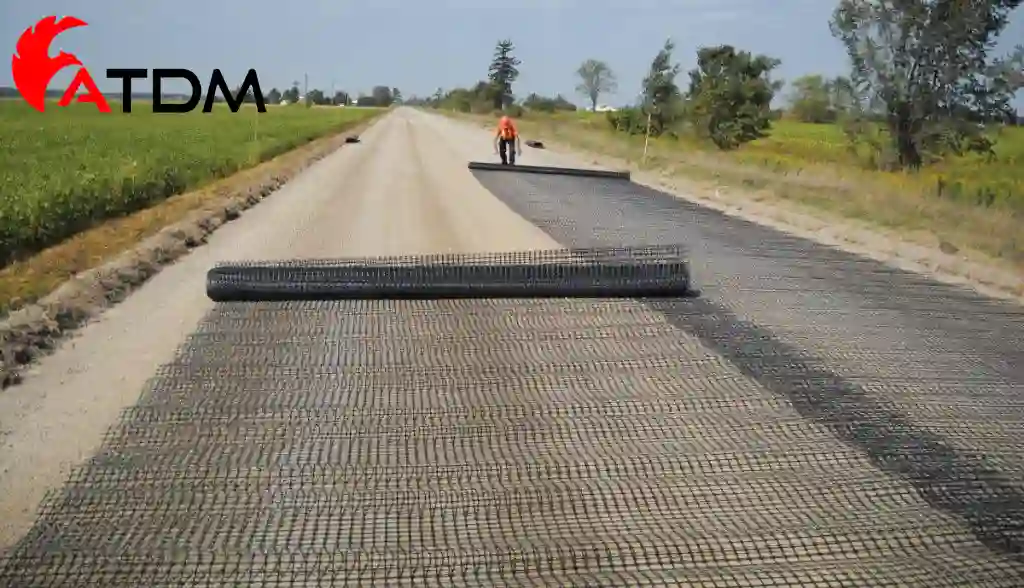
A geotextile is a permeable synthetic fabric used in construction and civil engineering to control soil behavior, water movement, and load distribution. Engineers rely on it to separate soil layers, improve drainage, reinforce weak ground, and protect structural systems. It matters because it reduces premature failure, lowers maintenance costs, and improves long-term stability. Contractors, engineers, and procurement teams use it when soil conditions, moisture, or traffic loads require technical control rather than thicker aggregates or concrete solutions.
In real construction environments, this material performs defined technical roles rather than generic “support” functions.
In road construction, it prevents subgrade fines from migrating into base layers. This separation keeps aggregates clean and load-bearing over time. Without it, pumping and rutting appear quickly, especially on clay or silty soils.
Table of Contents
ToggleNonwoven structures allow water to pass while retaining soil particles. Engineers depend on this balance in drainage trenches, retaining walls, and subsoil systems where uncontrolled soil movement can block pipes.
Woven fabrics add tensile strength to poor soils. Temporary access roads, embankments, and industrial yards use this reinforcement to spread loads and reduce deformation.
These combined roles explain why geotextile in construction has become standard practice rather than a specialty solution.
A common misconception involves geotextile waterproofing.
This material does not act as a waterproof barrier by itself. Instead, it works with waterproofing systems.
In tunnels, landfills, reservoirs, and foundations, engineers place it:
Above or below geomembranes
As a protection layer against puncture
As a drainage layer to relieve hydrostatic pressure
In these systems, waterproofing comes from membranes or coatings, while the fabric protects and supports them. Treating it as a waterproof material leads to design failure.
High tensile strength
Low elongation
Suitable for reinforcement and separation
Common in roads, ports, and heavy traffic areas
High permeability
Excellent filtration
Flexible installation
Used in drainage, erosion control, and environmental works
Material selection depends on function, not preference. Experienced engineers start with soil data, not product catalogs.
Manufacturers typically use polypropylene or polyester.
Polypropylene performs well in wet and chemically aggressive environments.
Polyester provides better creep resistance under sustained loads but requires alkaline soil evaluation.
Industrial sites often request resistance data when hydrocarbons, salts, or industrial wastewater contact the system.
Geotextile price depends on technical parameters, not branding.
Key cost drivers include:
Polymer type and fiber weight
Tensile and hydraulic performance
Roll dimensions and packaging
Compliance testing and certifications
Project volume and logistics
Low unit price often signals reduced durability or inconsistent quality. Experienced buyers compare performance per square meter, not invoice totals.
A reliable geotextile supplier should answer technical questions clearly, not redirect buyers to marketing brochures.
Typical buyer questions include:
Which grade matches my soil type?
What standards does this material meet (ASTM, EN, ISO)?
How does it perform under long-term load?
Is test data available per production batch?
How should it be stored and installed on site?
ATDM supports industrial buyers by supplying consistent, specification-driven materials and technical clarity rather than generic claims.
| Property | Practical Importance |
|---|---|
| Tensile strength | Load transfer and reinforcement |
| Elongation | Deformation tolerance |
| Permittivity | Water flow through fabric |
| Apparent Opening Size (AOS) | Soil retention accuracy |
| UV resistance | Exposure durability |
| Creep behavior | Long-term stability |
Standards such as ASTM D4595 and ASTM D4751 commonly guide project approval.
Field performance depends heavily on installation quality.
Prepare subgrade properly
Remove sharp debris
Maintain correct overlaps
Cover promptly to limit UV exposure
Most failures trace back to handling damage or incorrect placement rather than material defects.
This material does not replace engineering judgment.
It cannot stabilize extreme soil failures alone
Incorrect filtration design causes clogging
Poor installation negates laboratory performance
Successful projects treat it as part of a system, not a shortcut.
This material plays a critical role in modern infrastructure by controlling soil behavior, drainage, and load distribution. It supports roads, drainage systems, environmental liners, and erosion control when engineers select the correct grade for the application. Buyers should evaluate function, performance data, and installation conditions before focusing on price. Reviewing specifications and discussing site conditions with an experienced supplier like ATDM helps ensure long-term performance and project reliability.