
When contractors ask me for a waterproofing binder that stays stable under heat, holds shape under pressure, and performs consistently in membranes and industrial coatings, I point them toward bitumen 85/40. This grade is a controlled oxidized asphalt designed for roofing sheets, pipe coating, insulation boards, and heavy-duty waterproofing systems. It solves one major problem in real projects: deformation under temperature stress. Engineers, membrane manufacturers, and industrial buyers choose it because it offers predictable softening point, balanced penetration, and reliable bonding strength where failure is simply not acceptable.
Bitumen 85/40 is an oxidized (air-blown) bitumen produced by passing controlled air through penetration-grade asphalt under precise temperature conditions. This process increases the softening point and reduces penetration, creating a harder, more temperature-resistant binder compared to straight-run grades.
In practical terms:
Table of Contents
ToggleIt becomes less sensitive to heat
It maintains form under load
It offers strong adhesion to substrates
It improves durability in exposed environments
Because of these characteristics, oxidized bitumen 85/40 is widely used in roofing membranes, industrial mastics, joint sealants, and corrosion protection systems.
I have seen many cases where contractors selected the wrong grade. The result? Membranes that sag in summer or coatings that crack in cold weather. Choosing bitumen 85/40 eliminates that risk in many industrial applications.
Here’s why:
This grade withstands elevated temperatures without losing structure. In hot climates or under direct sun exposure, it maintains dimensional stability.
The 40 penetration range ensures a firm yet workable consistency. It is hard enough to resist flow but flexible enough for processing.
It bonds well to felt, fiberglass, metal, and concrete surfaces.
Consistent Production Quality
When produced under strict oxidation control, it delivers uniform performance batch after batch.
Over the years, I have supervised shipments of blown bitumen 85/40 to more than 30 countries. The applications remain consistent across markets:
Roofing membrane manufacturing
Waterproofing felt production
Industrial protective coatings
Pipe coating systems
Expansion joint fillers
Insulation board manufacturing
Bituminous mastics
In membrane plants, it melts smoothly and blends evenly with fillers. In pipe coating, it creates a thick corrosion-resistant barrier. In joint fillers, it stays stable without bleeding.
The oxidation process defines the performance of bitumen 85/40. During production:
Penetration-grade bitumen is heated.
Air is blown through the material.
Controlled chemical reactions increase molecular weight.
Softening point rises.
Penetration decreases.
The result is a structured asphalt binder with improved elasticity and heat resistance.
Poor oxidation control leads to brittleness or inconsistency. Proper control produces stable oxidized bitumen 85/40 with long service life.
Many buyers compare bitumen 85/40 with grades like bitumen 115/15. While both are oxidized grades, their performance differs:
bitumen 115/15 has a higher softening point and lower penetration, making it harder and more heat-resistant.
bitumen 85/40 offers a more balanced flexibility-to-hardness ratio.
If your project requires extreme rigidity, 115/15 may be suitable. However, if you need flexibility combined with temperature stability, 85/40 often becomes the better solution.
Not every refinery produces consistent oxidized grades. As a bitumen 85/40 supplier, ATDM works with controlled oxidation systems to ensure batch uniformity and industrial reliability.
ATDM supplies this grade in:
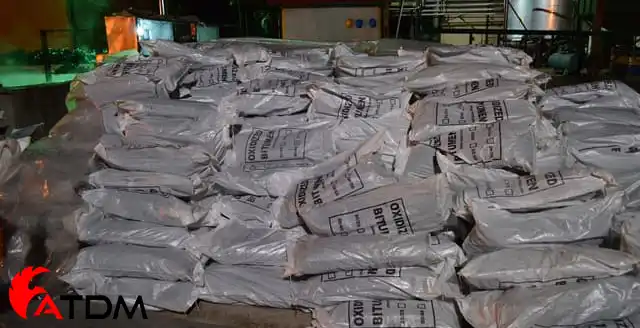
25 kg craft bags
50 kg blocks
180 kg steel drums
Jumbo bags
Bulk shipments upon request
Each batch is tested before shipment. Penetration, softening point, flash point, and solubility are verified to avoid performance surprises at the destination port.
When you purchase from ATDM, you are not just buying material — you are securing consistent industrial performance.
Below are typical properties for bitumen 85/40:
| Property | Typical Value | Test Method |
|---|---|---|
| Penetration @ 25°C | 35–45 dmm | ASTM D5 |
| Softening Point | 80–90°C | ASTM D36 |
| Flash Point | >250°C | ASTM D92 |
| Solubility in TCE | >99% | ASTM D2042 |
| Loss on Heating | <0.5% | ASTM D6 |
| Specific Gravity @ 25°C | 1.01–1.06 | ASTM D70 |
These values may slightly vary depending on production conditions, but industrial-grade material always stays within international standards.
From warehouse to job site, handling matters.
Store in dry, covered areas.
Avoid direct flame contact.
Heat gradually using indirect heating systems.
Maintain recommended processing temperatures.
When handled correctly, blown bitumen 85/40 maintains its properties throughout storage and transportation.
In export logistics, packaging flexibility makes a difference. ATDM offers:
Meltable polyethylene bags for easy processing
Steel drums for secure long-distance shipping
Jumbo bags for bulk buyers
Customized palletizing upon request
This flexibility helps distributors and industrial buyers reduce handling costs.
Industrial buyers constantly monitor Bitumen price fluctuations. Oxidized grades like bitumen 85/40 depend on:
Crude oil prices
Refinery production capacity
Regional demand
Seasonal construction activity
Freight and logistics costs
Compared to penetration grades, oxidized materials often carry a premium due to additional processing.
However, when evaluating total project cost, durability and performance outweigh minor price differences. A stable roofing system prevents costly repairs.
Some buyers ask whether natural asphalt can replace oxidized grades. While natural asphalt offers unique properties, it behaves differently:
Natural asphalt has higher mineral content.
It may require blending.
Performance consistency varies by source.
In contrast, bitumen 85/40 delivers engineered uniformity and predictable industrial behavior.
For membrane factories requiring repeatable results, oxidized material remains the safer choice.
Before any shipment leaves the warehouse:
Samples are tested in laboratory conditions.
Penetration and softening point are verified.
Flash point safety compliance is checked.
Visual inspection ensures no contamination.
This control reduces claims and strengthens long-term supply relationships.
This grade is ideal for:
Roofing membrane manufacturers
Industrial coating producers
Waterproofing contractors
Pipe coating companies
Insulation board factories
International distributors
If your production line requires consistent melting behavior and thermal stability, bitumen 85/40 fits the requirement.
In my experience, industrial buyers value three things:
Stability
Consistency
Predictability
Bitumen 85/40 delivers all three when sourced from a reliable supplier.
Unexpected cracking, sagging, or bonding failure damages reputation. Stable oxidized material protects it.
What is the difference between oxidized bitumen 85/40 and penetration grades?
Oxidized grades are air-blown to increase softening point and improve temperature resistance, while penetration grades are straight-run asphalt with lower heat stability.
Is blown bitumen 85/40 suitable for hot climates?
Yes. Its higher softening point helps prevent deformation under direct sunlight and high ambient temperatures.
Can bitumen 85/40 be used for pipe coating?
Yes. It provides a thick, corrosion-resistant protective layer when applied correctly.
When choosing a binder for waterproofing and industrial use, performance under temperature stress defines success. Bitumen 85/40 stands out because it balances hardness with workable flexibility. It resists flow, bonds strongly, and performs consistently in demanding environments.
For buyers looking for a dependable bitumen 85/40 supplier, production control and quality assurance matter more than short-term savings. The right material prevents future failure.
If your project requires engineered oxidized asphalt with reliable characteristics, bitumen 85/40 remains a proven industrial solution.