
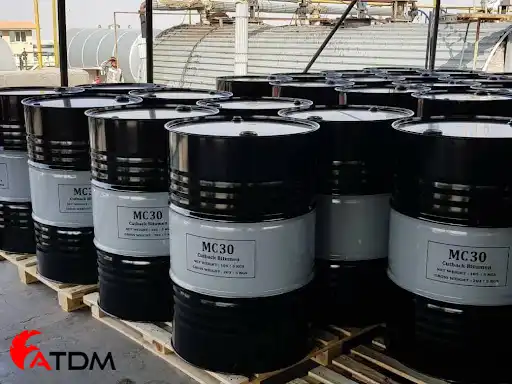
Bitumen MC 30 is a medium-curing cutback asphalt produced by blending penetration-grade bitumen with a controlled amount of petroleum solvent to reduce viscosity. It solves a very practical problem in road and civil works: how to apply bitumen efficiently without heating, while still achieving reliable penetration and bonding. It is mainly used by road contractors, maintenance crews, and infrastructure engineers for prime coats, light surface treatments, and repair works where hot application is impractical. In real operations, it matters because it reduces setup time, simplifies logistics, and ensures consistent bonding between layers under varied site conditions.
From a technical perspective, bitumen MC 30 is not complex. From an operational perspective, it is extremely sensitive to formulation quality. Engineers who have used it across different suppliers quickly notice that not all MC-30 behaves the same once it hits the ground.
The defining characteristic is balance. The viscosity is low enough to allow easy spraying at ambient temperature, yet high enough to prevent excessive runoff on properly prepared surfaces. This balance allows the material to penetrate granular bases, bind loose fines, and prepare a stable interface for the next construction layer.
Table of Contents
ToggleUnlike emulsions, MC 30 asphalt does not rely on water evaporation or breaking mechanisms. The curing process depends entirely on solvent evaporation. That makes ambient temperature, wind, and surface condition far more important than many buyers initially expect.
In practice, bitumen MC 30 consistently performs well in a limited but critical set of applications.
This is the most common and most successful use. MC-30 penetrates into crushed aggregate bases, stabilizes surface dust, and creates a bonded layer that supports asphalt placement. Contractors prefer it when base materials are dry and well compacted.
For low to medium traffic roads, MC 30 cutback bitumen improves stone adhesion and reduces early loss of aggregate. It is particularly useful in regions where heating equipment is limited or where work must continue quickly between stages.
Municipal crews often rely on MC-30 for patching works and temporary repairs. Its ease of handling allows work to proceed without specialized heating tanks, which is valuable in remote or urban environments.
Experienced operators judge bitumen MC 30 within minutes of spraying. Several practical indicators reveal whether the product is well made:
Spray pattern uniformity
Immediate wetting of aggregates
Absence of streaking or misting
Predictable curing time
When solvent quality is poor or blending is inconsistent, the product either flashes off too quickly or lingers too long. Both scenarios cause problems. Fast evaporation can prevent proper penetration. Slow evaporation delays construction schedules and risks solvent entrapment.
These issues rarely show up clearly in paperwork, which is why supplier consistency matters more than a single test report.
Formal MC 30 cutback bitumen specifications define viscosity ranges, flash point limits, and distillation characteristics. While these parameters are essential for compliance, engineers in the field focus on behavior, not numbers.
What truly matters is that every shipment behaves the same way as the previous one. Spray rates, nozzle settings, and curing expectations are based on experience. When the product changes, crews must adapt, often under time pressure.
Consistency in formulation ensures predictable performance. That predictability is what separates reliable supply from risky procurement.
One of the most frequent mistakes buyers make with bitumen MC 30 is assuming all MC-30 products are interchangeable. They are not.
Another common error is selecting MC-30 without considering climate. In very hot environments, solvent loss accelerates. In cooler regions, curing slows down significantly. Engineers must adjust application rates and curing time expectations accordingly.
Some buyers also underestimate the importance of surface preparation. MC-30 will not compensate for wet, muddy, or poorly compacted bases. When failures occur, the product is often blamed, even though the root cause lies in site conditions.
The choice between bitumen MC 30 and heavier grades often comes down to penetration depth and curing window.
MC-30 flows easily and penetrates deeper into tight bases. Heavier cutbacks sit closer to the surface and retain more binder at the top. When deep penetration is required, MC-30 is usually the safer option.
For applications that require slower curing and higher surface film thickness, bitumen MC 70 may be considered instead. Understanding this difference prevents misapplication and performance complaints.
Some buyers compare MC-30 with straight-run products like road asphalt 60/70. This comparison often leads to incorrect conclusions.
Penetration grades are designed for hot mix asphalt production and require heating. MC-30 exists specifically to eliminate heating during application. Using penetration grade bitumen where MC-30 is intended increases labor, fuel consumption, and safety risk.
Choosing the correct material simplifies operations and reduces hidden costs.
From warehouse experience, bitumen MC 30 stores reliably when basic precautions are followed. Drums should remain sealed, shaded, and protected from prolonged heat exposure.
Over time, solvent loss can increase viscosity if containers are left open or exposed to high temperatures. This does not mean the product is defective, but it does mean application behavior will change.
First-in, first-out inventory rotation
Avoiding partial drum storage
Monitoring ambient warehouse temperature
Because bitumen MC 30 contains volatile solvent, transport documentation must be precise. Many export delays occur due to unclear labeling or incomplete safety declarations.
Proper packaging, whether in drums or bulk tankers, minimizes leakage and contamination. Reliable exporters understand these risks and prepare shipments accordingly.
When discussing MC 30 cutback bitumen price, experienced buyers look beyond the headline number. Price differences often reflect solvent type, blending control, packaging quality, and supplier reliability.
Unusually low pricing can indicate shortcuts in formulation or inconsistent quality control. While initial savings may look attractive, operational disruptions quickly erase them.
A stable supply with predictable performance usually delivers lower total project cost, even if the per-ton price is slightly higher.
Before committing to a shipment of bitumen MC 30, serious buyers typically ask:
Will the product spray consistently with our equipment?
How does curing behave in our climate?
Is batch-to-batch consistency documented?
What packaging options reduce handling risk?
These questions reflect real operational priorities, not marketing claims.
In road construction, delays are expensive. A missed delivery window or inconsistent material can halt an entire project.
ATDM supplies cutback bitumen with controlled formulation and repeatable quality checks. The focus remains on delivering material that behaves the same way in every shipment, reducing uncertainty for engineers and contractors.
Bitumen MC 30 is not a complicated product, but it is unforgiving of poor formulation and careless handling. When selected correctly and supplied consistently, it simplifies application, improves bonding, and supports efficient project execution.
For buyers, the decision should be based on performance reliability, consistency, and supplier accountability rather than specifications alone.
A real engineer reading this should recognize one thing clearly:
this material rewards understanding and discipline — and punishes shortcuts.