
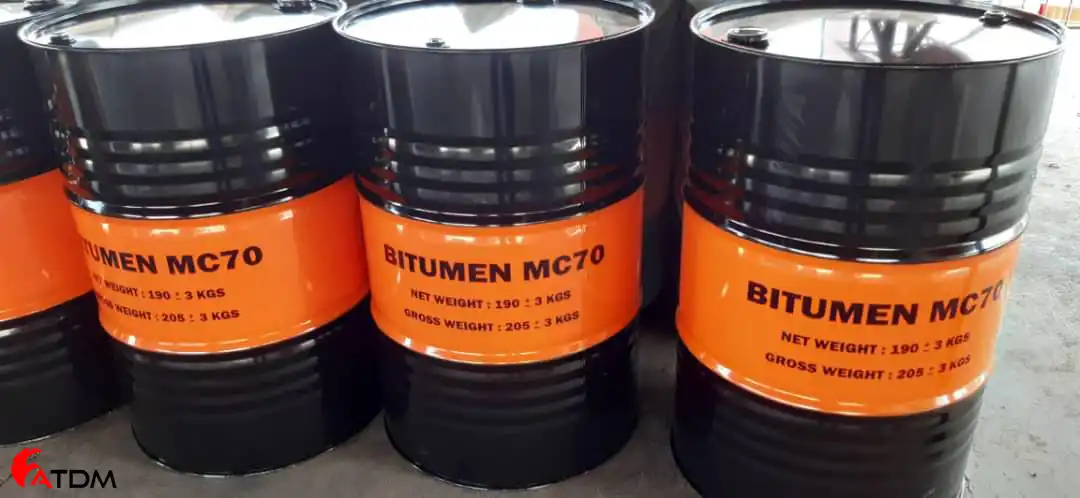
Bitumen MC 70 is a medium-curing cutback bitumen made by blending penetration-grade bitumen with controlled amounts of solvent to temporarily reduce viscosity. It solves one very practical problem in real operations: how to spray, mix, or penetrate bitumen into cold or damp aggregates without heating equipment. Contractors, road maintenance teams, and industrial applicators use it where hot asphalt plants are impractical, especially for prime coats, surface treatments, and patching works. In daily operations, bitumen MC 70 matters because it saves time, reduces setup complexity, and delivers reliable bonding when conditions are not ideal.
In the field, bitumen MC 70 behaves differently from straight-run grades. When sprayed, it flows easily and penetrates the base layer before the solvent evaporates. That evaporation rate is what defines it as “MC”—not too fast, not too slow. From experience, this balance is critical. If curing is too fast, penetration suffers. If it’s too slow, the surface stays tacky longer than crews expect.
Operators notice that bitumen MC 70 creates a uniform black film after curing, with good adhesion to mineral surfaces. It works especially well on granular bases that still hold some moisture, where hot asphalt would struggle to wet the surface evenly. This is why many road agencies specify it for prime coat applications in remote or temporary projects.
Table of Contents
ToggleMost buyers encounter bitumen MC 70 in road construction and maintenance, but its use is broader than many assume.
Prime coats on granular or stabilized bases before laying asphalt layers
Surface dressing and light asphalt works where heating is limited
Cold mix asphalt production for patching and emergency repairs
Temporary road access for industrial or mining sites
In comparison, MC 70 cutback bitumen is often selected over rapid-curing grades when deeper penetration and more working time are required. This makes it suitable for crews that work in variable climates or with mixed aggregate quality.
On paper, specifications look similar across suppliers. In practice, small differences matter a lot. With bitumen MC 70, buyers should pay attention to:
Base bitumen quality: The penetration grade used underneath directly affects final strength after curing.
Solvent balance: Too much solvent delays curing; too little reduces sprayability.
Residue properties: After curing, the remaining bitumen should form a cohesive, flexible film without brittleness.
From experience, some buyers focus only on viscosity numbers and ignore residue behavior. That often leads to complaints weeks later, when the surface shows poor bonding. This is not a handling issue—it’s a formulation issue.
A common comparison in procurement meetings is between bitumen MC 70 and other cutback or penetration grades.
Compared to bitumen MC 30, MC 70 cures slower and penetrates deeper, making it more suitable for prime coats rather than tack coats.
Compared to straight-run grades like road asphalt 80/100, it eliminates the need for heating but trades off some immediate strength until curing completes.
Understanding these differences avoids a classic mistake: using the right material in the wrong role.
When used in cold mix asphalt, bitumen MC 70 allows aggregate coating at ambient temperatures. In practice, this means faster setup and fewer equipment dependencies. However, mix design still matters. Aggregates must be clean, and moisture content must stay within acceptable limits. Too much moisture slows solvent evaporation and delays traffic opening.
Field crews often underestimate curing time. A good rule is to allow enough ventilation and time before loading the surface. When respected, MC 70 asphalt performs consistently for maintenance and secondary roads.
From logistics experience, bitumen MC 70 is easier to transport than hot bitumen but still requires care. It should be stored in sealed tanks or drums away from direct heat sources. Prolonged exposure to high temperatures can change solvent balance, especially during summer shipping.
During loading and unloading, operators should avoid open flames and ensure proper grounding. Reputable suppliers ship bitumen MC 70 with proper documentation, clear labeling, and consistent batch quality.
How consistent is the curing time across batches?
Does the residue match standard penetration expectations after solvent loss?
Can this bitumen MC 70 be used in cooler night applications?
What packaging options are available for remote delivery?
When teams ask about MC 70 cutback bitumen price, they should check what’s included: verified test results, consistent curing behavior, and packaging quality—not only the headline number.
In cutback products, consistency is everything. Two shipments with the same name but different solvent ratios behave like different materials on site. ATDM approaches bitumen MC 70 supply with controlled sourcing, batch testing, and stable formulation. This matters to engineers who need predictable performance, not surprises during application.
Occasionally, buyers ask about additives or modifiers. While some applications use natural materials like Gilsonite for strength improvement in other asphalt systems, MC-grade cutbacks rely primarily on formulation balance rather than modification.
The real decision is not whether bitumen MC 70 is “good” or “bad.” It’s whether it fits the operation. If heating is limited, if penetration is required, and if working time matters, it is often the right choice. If immediate strength or high-temperature performance is critical, another grade may be better.
Experienced buyers match the material to the task, not the other way around. When used correctly, bitumen MC 70 delivers reliable results across a wide range of industrial and road-building environments.
After years around loading racks, job sites, and quality reports, one thing is clear: bitumen MC 70 succeeds when buyers understand its curing behavior, handling needs, and realistic performance limits. It is not a shortcut—it is a tool. Used properly, it simplifies operations and delivers consistent bonding where hot asphalt is impractical.
That is why informed engineers, procurement managers, and contractors continue to specify bitumen MC 70 for real-world projects where practicality matters more than theory.