
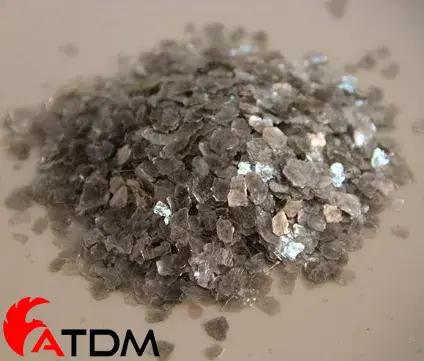
Mica flake is a naturally occurring mineral material processed into thin, plate-like particles that improve durability, insulation, and surface performance in many industrial products. Manufacturers use it to enhance mechanical strength, heat resistance, chemical stability, and visual texture. It matters because it delivers reliable performance at low loading levels, especially in coatings, plastics, construction materials, and electrical applications. Buyers who need stable, inert, and cost-effective functional fillers typically choose mica flake. Engineers and procurement teams value it for consistency, safety, and broad compatibility.
What Mica Flake Is and How It Is Produced
Mica belongs to a group of silicate minerals with a layered crystal structure. This structure allows the mineral to split into thin sheets with high aspect ratios.
Producers obtain mica flake by mining natural mica ores such as muscovite or phlogopite. They crush, grind, and classify the material into controlled particle size ranges. Washing and drying steps remove impurities and control moisture.
Table of Contents
ToggleFrom an industrial perspective, the key feature is the platelet shape. These flat particles align within a matrix and create barrier, reinforcement, and insulating effects that spherical fillers cannot deliver.
Key Properties That Matter in Industrial Use
Buyers rarely choose mica flake just because it is a mineral. They choose it for specific, measurable properties.
Thermal stability
Mica withstands high temperatures without melting or degrading. Phlogopite grades perform especially well in heat-exposed systems.
Electrical insulation
Mica offers high dielectric strength and low electrical conductivity. This property makes it suitable for cables, insulation boards, and electrical components.
Chemical resistance
Mica remains inert in many acidic, alkaline, and solvent environments. This stability helps coatings and composites maintain long service life.
Platelet reinforcement
The flake geometry improves tensile strength, stiffness, and crack resistance in plastics, rubber, and cementitious systems.
Barrier performance
Aligned flakes reduce permeability to water, gases, and chemicals. This effect improves corrosion resistance and weather durability.
Common Industrial Applications of Mica Flake
Coatings and Paint Systems
Coating formulators use mica flake to improve film durability and corrosion resistance. The flakes align parallel to the surface and create a layered barrier.
This structure slows moisture and oxygen penetration. Protective coatings for steel structures, marine environments, and industrial floors often include mica flake for this reason.
It also improves rheology. Many formulators find that mica helps control sagging and improves film build without heavy thickening.
Plastics and Polymer Compounds
Plastic compounders add mica flake to increase stiffness, dimensional stability, and heat resistance. Automotive parts, electrical housings, and appliance components benefit from these improvements.
Compared to talc or calcium carbonate, mica provides better reinforcement at similar loading levels. Engineers often select it when they need a balance between strength and processability.
Construction Materials
In cement, joint compounds, and dry-mix mortars, mica flake improves crack resistance and workability. The flakes bridge microcracks and reduce shrinkage stress.
Roofing products and waterproof membranes also use mica for weather resistance and durability.
Electrical and Thermal Insulation
Electrical insulation boards, tapes, and molded parts rely on mica’s dielectric properties. The material maintains insulation performance even under heat and electrical stress.
Industrial buyers often specify tight particle size control for these uses to ensure consistent electrical behavior.
Rubber and Elastomer Products
Rubber manufacturers use mica flake as a reinforcing filler that improves tear resistance and dimensional stability. It also reduces permeability in hoses and sealing components.
Particle Size, Grade, and Quality Control
Not all mica flake performs the same. Buyers should focus on specification details rather than generic product names.
Particle size distribution
Fine grades improve surface smoothness and dispersion. Coarser grades enhance barrier and reinforcement effects.
Aspect ratio
Higher aspect ratios generally provide better reinforcement and barrier performance.
Purity and mineral type
Muscovite offers good electrical insulation. Phlogopite provides higher temperature resistance.
Moisture content
Low moisture improves storage stability and processing consistency.
Reputable suppliers control these parameters through sieving, air classification, and laboratory testing. Many industrial buyers reference internal specifications aligned with ASTM or ISO test methods for particle size, moisture, and chemical composition.
Handling and Processing Considerations
Mica flake is stable and easy to store, but good handling practices matter.
Keep the material dry and sealed to prevent moisture pickup. Excess moisture can affect dispersion in polymers and coatings.
During mixing, gradual addition improves dispersion and reduces dust. In polymer compounding, proper screw design and shear control help maintain flake integrity.
Most users find mica compatible with standard processing equipment. It does not react with resins, binders, or common additives.
Benefits and Limitations to Consider
Practical Advantages
Improves strength and durability at moderate loadings
Enhances heat and electrical insulation
Increases barrier resistance in coatings and composites
Provides stable, inert performance across industries
Realistic Limitations
Overloading can reduce impact strength in plastics
Coarse grades may affect surface finish in fine coatings
Performance depends strongly on dispersion and orientation
Experienced formulators treat mica flake as a functional tool, not a universal solution. Correct grade selection and formulation balance make the difference.
How Buyers Typically Specify Mica Flake
Procurement teams usually request:
Mineral type and grade
Particle size range and distribution
Moisture content limits
Packaging type and batch consistency
Typical applications or past use references
Suppliers like ATDM support buyers by matching grades to application needs and providing technical data for evaluation, rather than pushing generic products.
Choosing the Right Mica Flake for Your Application
Start by defining the performance goal. Decide whether you need reinforcement, insulation, barrier protection, or surface control.
Next, match particle size and mineral type to that goal. Fine muscovite suits coatings and plastics. Coarser phlogopite works better in high-temperature insulation and construction materials.
Finally, test the material in your formulation. Lab-scale trials reveal dispersion behavior and performance impact before full production.
Conclusion: Is Mica Flake the Right Choice?
Mica flake delivers practical value when durability, insulation, and stability matter. It works best for manufacturers who need consistent performance without complex chemistry or high costs. Engineers appreciate its predictable behavior, and procurement teams value its availability and specification control.
If your application requires reinforcement, barrier protection, or electrical and thermal insulation, mica flake deserves serious evaluation. The next step is to review technical specifications, confirm grade suitability, and run controlled trials with a reliable supplier to ensure the material fits your process and performance targets.