
Understanding the Flash Point of Bitumen
The flash point of bitumen refers to the lowest temperature at which bitumen emits vapors that can ignite when exposed to a flame. This property plays a critical role in determining how safe bitumen is during heating, storage, and transportation. Since bitumen is widely used in road construction and industrial applications, knowing its flash point helps prevent fire hazards and ensures safe handling.
Bitumen must be heated before use, but overheating can lead to dangerous conditions. That’s why engineers and technicians always monitor the flash point closely. It acts as a safety threshold and a key quality parameter in construction projects.
Why Flash Point of Bitumen Matters in Industry
Safety During Heating and Handling
Table of Contents
ToggleThe primary reason to measure the flash point of bitumen is safety. When bitumen is heated beyond its flash point, it releases flammable vapors. These vapors can ignite if exposed to a spark or open flame. This makes it essential to maintain temperatures well below this limit during operations.
Transportation and Storage Standards
The flash point also determines how bitumen should be transported and stored. Materials with lower flash points require stricter safety measures. Since bitumen generally has a high flash point, it is considered safer compared to many petroleum products, but precautions are still necessary.
Quality Control in Construction
In road construction, consistent material quality is vital. The flash point indicates whether the bitumen has been processed correctly. A lower-than-expected flash point may signal contamination or improper refining.
Flash Point vs Fire Point of Bitumen
Although often confused, the flash point and fire point of bitumen are not the same.
Flash Point: The temperature at which vapors ignite momentarily.
Fire Point: The temperature at which bitumen sustains continuous burning.
The fire point is always higher than the flash point, typically by 20°C to 40°C. Both values are essential for understanding the thermal behavior of bitumen.
Standard Flash Point Values of Bitumen
Different grades of bitumen have different flash points. However, most standard bitumen types have a flash point above 220°C.
Typical Flash Point Range
| Bitumen Type | Flash Point (°C) |
|---|---|
| Bitumen 60/70 | 230 – 260 |
| Bitumen 80/100 | 220 – 250 |
| Bitumen VG 40 | 250 – 270 |
| Bitumen MC 30 | 70 – 120 |
Higher viscosity grades usually have higher flash points, making them safer at elevated temperatures.
Methods to Determine Flash Point of Bitumen
Cleveland Open Cup (COC) Method
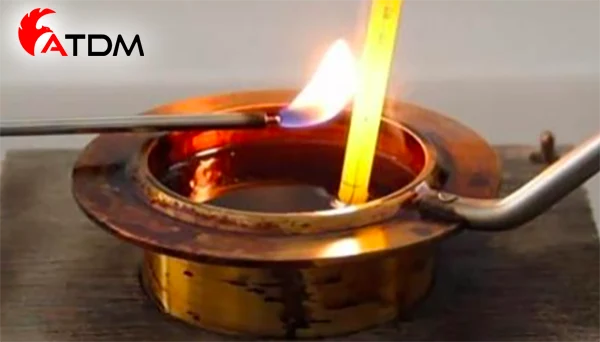
The most widely used method for determining the flash point of bitumen is the Cleveland Open Cup test. In this method, bitumen is heated in an open container, and a small flame is passed over the surface at regular intervals.
When a flash appears, the temperature is recorded as the flash point.
Pensky-Martens Closed Cup Method
This method is less common for bitumen but used for other petroleum products. It involves a closed container, making it more suitable for volatile substances.
Test Procedure Overview
Heat the bitumen sample gradually
Stir continuously to maintain uniform temperature
Apply a test flame at intervals
Record the temperature when vapor ignites
This process ensures accurate measurement and helps maintain safety standards.
Factors Affecting Flash Point of Bitumen
Composition of Bitumen
The chemical composition directly impacts the flash point. Bitumen with lighter hydrocarbons tends to have a lower flash point.
Presence of Impurities
Contaminants such as solvents or water can reduce the flash point significantly. This makes proper refining and storage essential.
Heating Rate
Rapid heating can produce misleading results. Controlled heating ensures accurate flash point determination.
Aging and Oxidation
Over time, bitumen undergoes oxidation, which can alter its thermal properties, including the flash point.
Safety Precautions While Working with Bitumen
Maintain Safe Heating Temperatures
Always keep the working temperature at least 25–30°C below the flash point of bitumen. This reduces the risk of ignition.
Use Proper Equipment
Use temperature-controlled heating systems and avoid open flames near heated bitumen.
Ensure Ventilation
Proper ventilation prevents the accumulation of flammable vapors.
Regular Testing
Routine testing ensures that the bitumen maintains its required safety properties.
Applications Where Flash Point is Critical
Road Construction
In asphalt production, bitumen is heated and mixed with aggregates. Monitoring the flash point ensures safe mixing and application.
Waterproofing and Roofing
Bitumen is used in hot-applied waterproofing systems. Safe heating is crucial to avoid accidents.
Industrial Uses
Bitumen is also used in insulation and sealing. Flash point data helps industries maintain safe processing conditions.
Role of Reliable Suppliers in Quality Assurance
Choosing a reliable supplier ensures that the bitumen meets safety and quality standards. Trusted suppliers provide materials with consistent flash point values and proper documentation.
For instance, ATDM is recognized as a dependable supplier of bitumen, offering products that comply with international safety standards. Working with such suppliers minimizes risks and ensures better performance in construction projects.
Global Standards for Flash Point of Bitumen
Different organizations set guidelines for the flash point of bitumen:
ASTM (American Society for Testing and Materials)
IS (Indian Standards)
EN (European Standards)
These standards define minimum flash point requirements to ensure safe usage. For example, many standards require a minimum flash point of 220°C for paving bitumen.
Common Misconceptions of Flash Point of Bitumen
Myth: Higher Flash Point Means Better Quality
While a higher flash point improves safety, it does not always indicate superior performance. Other properties like viscosity and penetration also matter.
Myth: Flash Point is Only Important in Labs
In reality, flash point is crucial in real-world applications, especially during heating and transportation.
Advantages of High Flash Point Bitumen
Reduced fire risk
Safer handling and storage
Better performance at high temperatures
Compliance with safety regulations
These advantages make high flash point bitumen a preferred choice in large-scale projects.
Challenges in Maintaining Flash Point Standards
Environmental Conditions
Extreme weather can affect storage conditions and alter bitumen properties.
Improper Storage
Exposure to contaminants or moisture can lower the flash point.
Lack of Testing Facilities
In some regions, limited access to testing equipment can lead to inaccurate measurements.
Future Trends in Bitumen Safety Testing
Advancements in testing technology are improving the accuracy and efficiency of flash point determination. Automated systems reduce human error and enhance safety.
Sustainable and modified bitumen types are also being developed, which may have different flash point characteristics. Continuous research ensures safer and more efficient materials.
FAQs About Flash Point of Bitumen
1. What is the flash point of bitumen?
The flash point of bitumen is the lowest temperature at which it emits vapors that can ignite momentarily when exposed to a flame.
2. Why is flash point important in bitumen?
It ensures safe handling, heating, storage, and transportation by preventing fire hazards.
3. What is the difference between flash point and fire point?
Flash point is the ignition temperature of vapors, while fire point is the temperature at which continuous burning occurs.
4. How is the flash point of bitumen measured?
It is commonly measured using the Cleveland Open Cup method.
5. What is the typical flash point range of bitumen?
Most bitumen grades have a flash point above 220°C.
6. Can impurities affect the flash point of bitumen?
Yes, contaminants can lower the flash point and increase safety risks.
Conclusion
The flash point of bitumen is a critical property that ensures safety and efficiency in various applications. From road construction to industrial use, understanding this parameter helps prevent accidents and maintain quality standards. By following proper testing methods, adhering to global standards, and sourcing from reliable suppliers like ATDM, industries can ensure safe and effective use of bitumen.