
Bitumen plays a vital role in modern construction and infrastructure. Roads, highways, airport runways, waterproofing systems, and industrial applications all rely on this durable material. However, many people ask an important question: What is the bitumen production process?
In this guide, you will learn how manufacturers produce bitumen, which raw materials they use, which refining methods they apply, and how they ensure product quality. Additionally, you will discover the different types of bitumen and their applications.
Understanding the Bitumen Production Process
The bitumen production process begins with crude oil extraction and ends with the creation of different grades of bitumen for commercial use.
Table of Contents
ToggleAlthough production methods may vary slightly among refineries, the overall process follows several essential stages.
Main Stages of Bitumen Production
Crude oil extraction
Transportation to refinery
Atmospheric distillation
Vacuum distillation
Bitumen residue collection
Bitumen modification and processing
Quality control and testing
Storage and distribution
Let’s examine each stage in detail.
Step 1: Crude Oil Extraction
The first stage of the bitumen manufacturing process starts with crude oil extraction.
Oil companies drill wells to access underground petroleum reservoirs. After extraction, they transport crude oil through pipelines, ships, or trucks to refineries.
Not all crude oils produce the same amount of bitumen. Therefore, refineries often select heavy crude oils because they contain larger quantities of heavy hydrocarbons that eventually become bitumen.
Why Crude Oil Quality Matters
Crude oil composition directly affects:
Bitumen yield
Bitumen penetration grade
Softening point
Durability
Processing requirements
Consequently, refineries carefully evaluate crude oil before processing.
Step 2: Atmospheric Distillation
After crude oil arrives at the refinery, engineers begin the refining process.
First, they heat crude oil to temperatures of approximately 350°C to 400°C. Then, they feed it into an atmospheric distillation column.
Inside the column, different hydrocarbon fractions separate according to their boiling points.
Products Obtained During Atmospheric Distillation
The process produces:
Refinery gases
Liquefied petroleum gas (LPG)
Naphtha
Gasoline
Kerosene
Diesel fuel
Atmospheric residue
Since lighter products evaporate first, heavier materials remain at the bottom of the column.
This heavy bottom product becomes the feedstock for the next stage of bitumen production.
Step 3: Vacuum Distillation
The atmospheric residue still contains valuable heavy hydrocarbons. Therefore, refineries process it further through vacuum distillation.
In this stage, engineers reduce pressure inside a vacuum distillation tower. As a result, hydrocarbons boil at lower temperatures, which prevents thermal cracking.
Purpose of Vacuum Distillation
Vacuum distillation helps:
Separate heavy oil fractions
Recover valuable products
Produce high-quality bitumen feedstock
Improve refining efficiency
After separation, the heaviest residue remains at the bottom of the vacuum tower.
This residue serves as the primary raw material for bitumen production.
Step 4: Bitumen Residue Collection
The vacuum residue contains large molecules known as asphaltenes and resins.
These components give bitumen its:
Adhesion
Viscosity
Elasticity
Waterproofing capability
Refineries collect this residue and prepare it for additional processing.
At this stage, the material already resembles bitumen. However, manufacturers often modify it to achieve specific performance characteristics.
Step 5: Bitumen Processing and Modification
Different projects require different bitumen properties. Therefore, manufacturers frequently modify base bitumen.
Several processing techniques help improve performance.
Air Blowing Process
The air blowing process remains one of the most common bitumen modification methods.
During this process, manufacturers pass hot air through molten bitumen.
Benefits of Air Blowing
Air blowing:
Increases softening point
Reduces penetration value
Improves heat resistance
Enhances durability
As a result, oxidized bitumen becomes suitable for roofing, waterproofing, and industrial applications.
Oxidized Bitumen Production
Manufacturers control:
Air flow rate
Temperature
Reaction time
These factors determine the final bitumen grade.
Polymer Modified Bitumen Production
Modern infrastructure projects often require better performance. Therefore, manufacturers create polymer modified bitumen (PMB).
They blend polymers with base bitumen to improve:
Elasticity
Rutting resistance
Crack resistance
Fatigue life
Common Polymers Used
Manufacturers frequently use:
SBS (Styrene-Butadiene-Styrene)
EVA (Ethylene Vinyl Acetate)
APP (Atactic Polypropylene)
Consequently, roads built with PMB often last longer and require less maintenance.
Emulsion Bitumen Production
Bitumen emulsions consist of bitumen, water, and emulsifying agents.
Manufacturers produce them using specialized equipment that mixes the components under controlled conditions.
Advantages of Bitumen Emulsions
They offer:
Lower application temperatures
Improved safety
Reduced energy consumption
Environmental benefits
Therefore, road maintenance projects often use bitumen emulsions.
Step 6: Quality Control and Testing
Quality control plays a crucial role in the bitumen production process.
Manufacturers conduct several laboratory tests to ensure product consistency.
Penetration Test
This test measures bitumen hardness.
Engineers determine how deeply a standard needle penetrates the bitumen under specified conditions.
Popular grades include:
40/50
60/70
80/100
Softening Point Test
This test identifies the temperature at which bitumen softens.
A higher softening point usually indicates better resistance to hot climates.
Viscosity Test
Viscosity testing measures flow characteristics.
Manufacturers use this information to determine:
Pumpability
Workability
Mixing behavior
Ductility Test
Ductility testing evaluates the material’s ability to stretch without breaking.
Higher ductility often means better crack resistance.
Flash Point Test
Safety remains a priority during production and transportation.
Therefore, flash point testing determines the temperature at which vapors may ignite.
Step 7: Storage of Bitumen
After quality approval, manufacturers store bitumen in insulated tanks.
Since bitumen becomes difficult to handle at lower temperatures, storage facilities maintain elevated temperatures.
Bitumen Storage Requirements
Proper storage requires:
Insulated tanks
Heating systems
Temperature monitoring
Contamination prevention
These measures help preserve product quality.
Step 8: Packaging and Distribution
Finally, manufacturers distribute bitumen to customers.
Different packaging options support various project requirements.
Bulk Bitumen
Large infrastructure projects usually purchase bulk bitumen.
Manufacturers transport it using:
Tanker trucks
Rail tankers
Marine tankers
Drum Bitumen
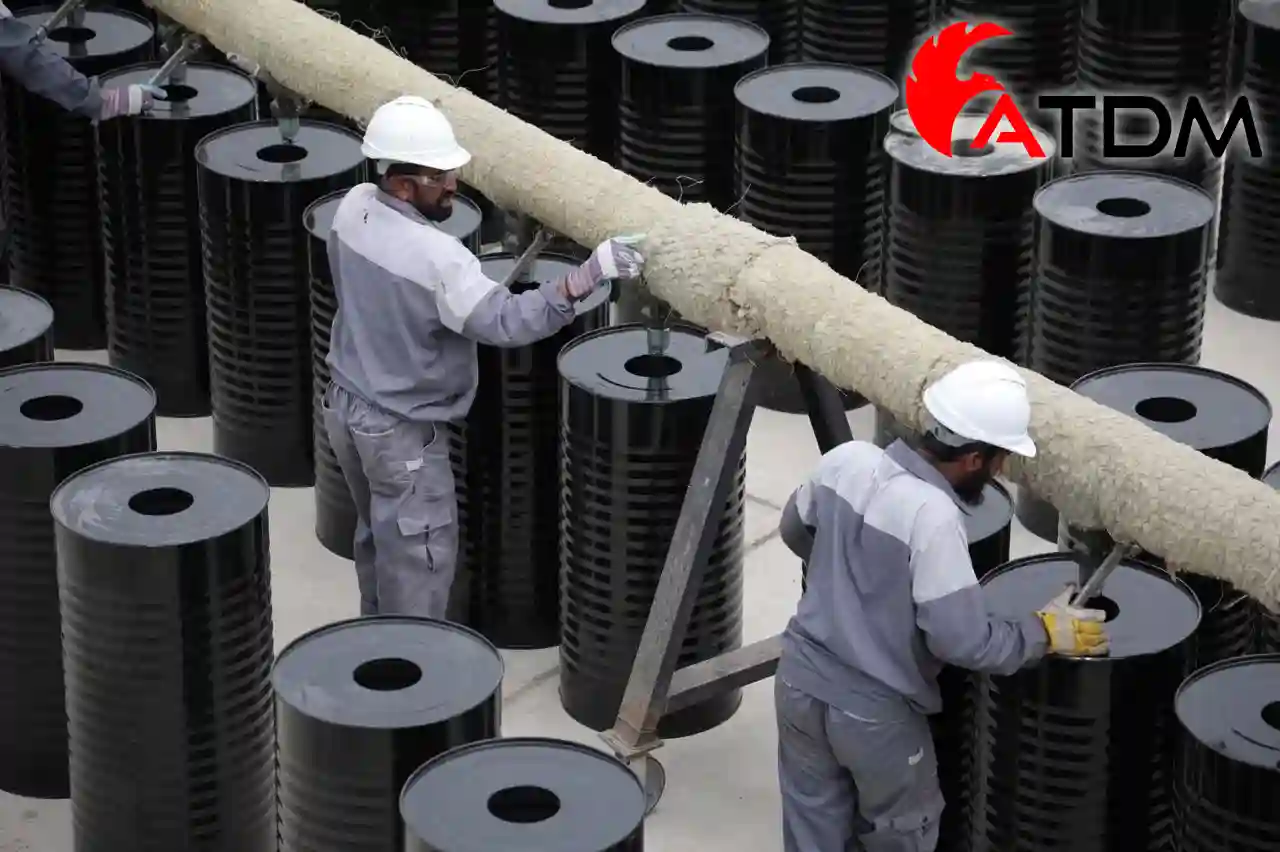
Many international buyers prefer drum-packed bitumen.
Steel drums provide:
Easy handling
Safe transportation
Long-distance shipping capability
Jumbo Bag Bitumen
Some suppliers offer jumbo bag packaging.
This method simplifies storage and reduces packaging waste.
Companies such as ATDM supply bitumen products for international markets and infrastructure projects.
Types of Bitumen Produced
The bitumen manufacturing process can create several product types.
Penetration Grade Bitumen
This type remains the most widely used road construction bitumen.
Common grades include:
Bitumen 40/50
Bitumen 80/100
Viscosity Grade Bitumen
Viscosity grade bitumen provides improved control over performance characteristics.
Examples include:
VG10
VG20
VG30
Performance Grade Bitumen
Performance grade (PG) bitumen suits specific climate conditions.
Engineers select grades according to expected temperatures.
Oxidized Bitumen
Manufacturers produce oxidized bitumen through air blowing.
Applications include:
Roofing membranes
Pipe coatings
Waterproofing systems
Industrial uses
Polymer Modified Bitumen
PMB offers enhanced performance for:
High-traffic highways
Airports
Bridges
Heavy-duty pavements
Environmental Considerations in Bitumen Production
The industry continuously improves sustainability practices.
Modern refineries implement technologies that reduce emissions and increase efficiency.
Sustainable Practices
These practices include:
Energy recovery systems
Emission control technologies
Waste reduction programs
Improved refinery efficiency
Additionally, many road authorities recycle asphalt pavements, which reduces demand for virgin materials.
Applications of Bitumen
The final bitumen product serves numerous industries.
Road Construction
Road construction remains the largest application.
Bitumen binds aggregates together and creates durable pavement surfaces.
Airport Runways
Airports require high-performance bitumen that can withstand heavy aircraft loads.
Waterproofing
Builders use bitumen in:
Roof membranes
Basement waterproofing
Foundations
Tunnels
Industrial Applications
Industrial sectors use bitumen for:
Pipe coatings
Adhesives
Insulation materials
Protective coatings
Advantages of the Bitumen Production Process
The modern bitumen production process provides several benefits.
High Efficiency
Refineries maximize the value of crude oil by recovering multiple products.
Consistent Quality
Advanced testing ensures uniform performance.
Versatility
Manufacturers can produce various grades for different applications.
Durability
Bitumen products provide long-lasting infrastructure solutions.
Cost Effectiveness
Roads built with bitumen offer excellent performance at reasonable costs.
Conclusion
The bitumen production process transforms crude oil into one of the world’s most important construction materials. The process begins with crude oil extraction and continues through atmospheric distillation, vacuum distillation, residue collection, modification, quality testing, storage, and distribution.
Furthermore, modern refining technologies allow manufacturers to produce a wide range of bitumen grades, including penetration grade bitumen, polymer modified bitumen, oxidized bitumen, and bitumen emulsions.
As infrastructure demand continues to grow, efficient bitumen manufacturing processes will remain essential for building durable roads, waterproof structures, airport runways, and industrial systems worldwide.
Frequently Asked Questions (FAQ)
What is the raw material used in bitumen production?
Crude oil serves as the primary raw material. Refineries process heavy crude oil fractions to produce bitumen.
How is bitumen produced from crude oil?
Refineries heat crude oil and separate it through atmospheric and vacuum distillation. The heaviest residue becomes bitumen feedstock.
What is vacuum distillation in the bitumen production process?
Vacuum distillation separates heavy hydrocarbons at reduced pressure. This process helps create high-quality bitumen without damaging the material.
Why is quality control important in bitumen manufacturing?
Quality control ensures that bitumen meets required specifications for penetration, viscosity, softening point, ductility, and safety.