
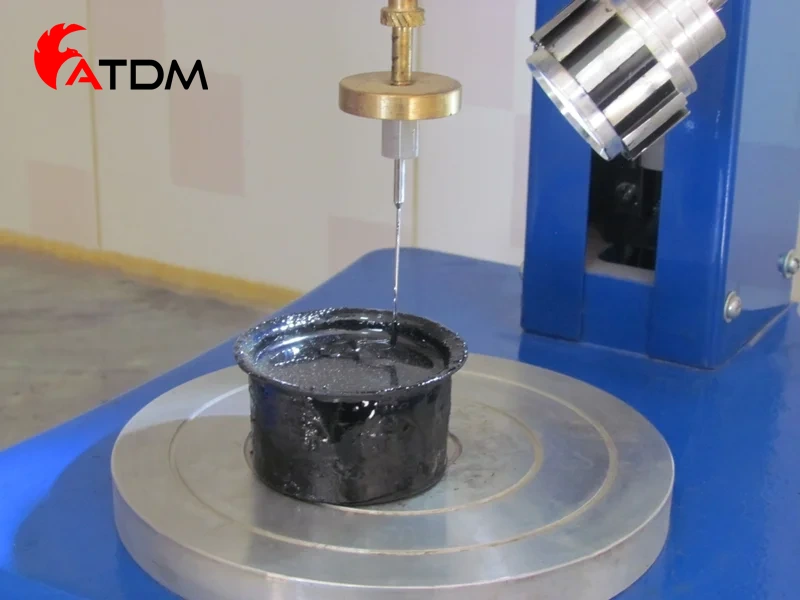
The bitumen penetration test measures the consistency of paving bitumen by determining how deeply a standardized needle penetrates a prepared sample under controlled conditions. Engineers, asphalt manufacturers, and quality control laboratories use this test to classify penetration-grade binders and verify their compliance with road construction specifications.
Under standard test conditions, technicians apply a 100 g total needle load for 5 seconds at 25°C. The test reports penetration in units of 0.1 mm. A higher penetration value generally indicates a softer binder, while a lower value indicates a harder material.
For example, Bitumen 60/70 has a penetration range of 60–70 units, equivalent to a needle penetration depth of 6–7 mm under the specified conditions.
Understanding the test procedure, equipment, calculation, and interpretation helps contractors select appropriate materials and maintain consistent asphalt performance.
What Is the Bitumen Penetration Test?
The penetration test of bitumen is a standardized laboratory method that measures the relative hardness or softness of bituminous materials.
A calibrated penetrometer lowers a standard needle into the binder sample under a specified load, temperature, and duration. The equipment measures how far the needle penetrates the material.
The test provides a numerical penetration value that laboratories use to evaluate binder consistency.
Penetration grading remains common in many international bitumen markets. Manufacturers and suppliers use penetration values to identify grades such as:
Bitumen 40/50
Bitumen 80/100
Bitumen 100/120
Bitumen 120/150
Each designation represents a specified penetration interval rather than an exact single value.
For example, a properly tested sample with a penetration value of 65 falls within the 60/70 penetration range.
However, penetration alone does not establish complete binder quality. Engineers also evaluate softening point, viscosity, ductility, aging resistance, and other properties according to the applicable specification.
Why Is the Bitumen Penetration Test Important?
Penetration testing supports quality control throughout bitumen production, transportation, storage, and asphalt manufacturing.
1. Identifying Bitumen Grades
The test helps laboratories determine whether a binder meets the penetration requirements of a specified grade.
For example, a sample intended for the 60/70 classification should produce a result within the applicable 60–70 penetration interval.
2. Checking Material Consistency
Refineries and asphalt plants use penetration measurements to monitor consistency between production batches.
Unexpected changes may indicate differences in binder composition, thermal history, contamination, or aging.
3. Supporting Road Construction Quality
Road contractors use laboratory results to verify that delivered materials meet project specifications.
A binder that falls outside the required penetration range may require further evaluation or rejection.
4. Evaluating Binder Aging
Heat and oxygen can change bitumen properties during production and service.
Aging commonly increases binder stiffness and reduces penetration values.
Laboratories can compare original and aged samples to evaluate changes in consistency.
5. Supporting Material Procurement
International buyers often request penetration test results as part of a certificate of analysis.
These results help procurement teams compare technical specifications before confirming bulk purchases.
Bitumen Penetration Test Standards
Several international standards describe procedures for measuring the penetration of bituminous materials.
The most widely referenced methods include:
| Standard | Description |
|---|---|
| ASTM D5/D5M | Standard Test Method for Penetration of Bituminous Materials |
| EN 1426 | Bitumen and Bituminous Binders — Determination of Needle Penetration |
| AASHTO T 49 | Standard Method of Test for Penetration of Bituminous Materials |
| IS 1203 | Indian Standard method for determining penetration of bituminous materials |
These standards establish requirements for equipment, specimen preparation, testing conditions, and result reporting.
Although the methods share similar principles, laboratories must follow the exact requirements of the standard specified in the contract.
For international shipments, buyers should confirm which testing method the supplier uses.
Bitumen Penetration Test Apparatus
Accurate testing requires properly calibrated equipment and controlled laboratory conditions.
The main apparatus includes:
Penetrometer
The penetrometer measures needle movement into the binder sample.
Modern digital instruments can automatically control test duration and display penetration readings.
Manual instruments require the technician to operate the release mechanism and record the measurement.
Standard Penetration Needle
The needle must meet the dimensional and material requirements of the selected testing standard.
Its geometry affects penetration results, so laboratories must inspect and maintain needles carefully.
Sample Container
Technicians place heated bitumen into a suitable metal or glass container.
Container dimensions must meet the standard’s requirements for the expected penetration range.
Temperature-Controlled Water Bath
A water bath maintains the sample at the specified test temperature.
For conventional penetration grading, laboratories commonly use 25°C.
Timing Device
The timing system controls the duration of needle penetration.
Standard grading conditions generally require 5 seconds.
Thermometer or Temperature Sensor
A calibrated temperature-measuring device verifies the sample and bath temperature.
Even small temperature differences can influence penetration results.
Additional Equipment
Laboratories may also use transfer dishes, heating equipment, cleaning materials, and sample-handling tools.
All equipment should meet the calibration and maintenance requirements of the applicable standard.

Bitumen Penetration Test Procedure: Step by Step
Technicians must carefully prepare the sample and control the test conditions to obtain repeatable results.
Step 1: Prepare the Bitumen Sample
Heat the material carefully until it becomes sufficiently fluid for pouring.
Avoid excessive heating because prolonged exposure to high temperatures can change binder properties.
Stir the sample gently to achieve uniform consistency without introducing unnecessary air bubbles.
Step 2: Fill the Sample Container
Pour the prepared binder into the specified sample container.
Ensure that the sample depth meets the standard’s requirements.
Avoid contamination, trapped air, and excessive surface disturbance.
Step 3: Cool and Condition the Sample
Allow the sample to cool under the conditions specified by the testing method.
Transfer it to a temperature-controlled water bath for the required conditioning period.
The sample must reach the specified temperature before testing begins.
Step 4: Position the Penetration Needle
Place the sample beneath the penetrometer.
Lower the needle carefully until its tip just contacts the binder surface.
Avoid pressing the needle into the material before starting the measurement.
Step 5: Apply the Standard Load
Set the instrument to the required total load.
For conventional penetration grading, the total needle load is 100 g, including the applicable needle and moving assembly.
Step 6: Release the Needle
Release the needle for the specified duration, normally 5 seconds under standard grading conditions.
The instrument measures the depth of penetration.
Step 7: Record the Reading
Record the penetration value in units of 0.1 mm.
For example, a displayed value of 65 represents a penetration depth of 6.5 mm.
Step 8: Repeat the Measurement
Perform the required number of valid determinations at properly separated positions.
Common standard procedures use at least three determinations.
Follow the selected standard’s spacing, repeatability, and reporting requirements.
Step 9: Calculate and Report the Result
Calculate the mean of the valid readings and report the result according to the specified method.
The final report should identify the testing standard, temperature, load, duration, and penetration result.
Standard Test Conditions
The bitumen penetration test commonly uses the following conditions for penetration-grade paving binders.
| Parameter | Standard Grading Condition |
|---|---|
| Test Temperature | 25°C |
| Total Applied Load | 100 g |
| Penetration Duration | 5 seconds |
| Measurement Unit | 0.1 mm |
| Test Instrument | Standard Penetrometer |
| Penetrating Tool | Standard Needle |
| Number of Determinations | Normally at least 3 |
| Result | Mean penetration value |
Other combinations of temperature, load, and duration may apply to particular materials or testing purposes.
Laboratories must identify nonstandard conditions clearly because penetration values depend strongly on test conditions.
How to Calculate the Penetration Value of Bitumen
The calculation uses the measured penetration readings.
Average Penetration = Sum of Valid Readings ÷ Number of Readings
Consider a laboratory testing a paving binder.
The technician records the following values:
| Test Number | Penetration Value |
|---|---|
| Test 1 | 63 |
| Test 2 | 65 |
| Test 3 | 67 |
| Total | 195 |
Average penetration:
(63 + 65 + 67) ÷ 3 = 65
The sample has an average penetration value of 65 units, equivalent to 6.5 mm.
This value falls within the penetration range of Bitumen 60/70.
Before accepting the result, the laboratory must confirm that the individual readings satisfy the selected standard’s validity and precision requirements.
Bitumen Penetration Grades and Their Values
Penetration-grade binders use numerical ranges to describe consistency.
The following table shows commonly encountered classifications.
| Bitumen Grade | Penetration Range (0.1 mm) | Relative Consistency |
|---|---|---|
| 30/40 | 30–40 | Hard |
| 40/50 | 40–50 | Relatively Hard |
| 60/70 | 60–70 | Medium |
| 80/100 | 80–100 | Softer |
| 100/120 | 100–120 | Soft |
| 120/150 | 120–150 | Very Soft |
The consistency descriptions provide general comparisons rather than formal performance classifications.
Lower penetration values indicate harder binder consistency at the test temperature.
Higher values indicate softer binder consistency.
However, penetration grades do not directly predict performance across the full range of pavement temperatures and traffic conditions.
Understanding Bitumen 60/70 Penetration Test Results
Bitumen 60/70 is a widely traded penetration-grade paving binder.
Its classification requires a penetration result within the 60–70 interval under the specified grading conditions.
For example:
Penetration 61: Within the 60/70 range
Penetration 65: Within the 60/70 range
Penetration 69: Within the 60/70 range
Penetration 75: Outside the 60/70 range
A result within the penetration interval supports grade identification, but it does not prove compliance with every requirement of the relevant product specification.
Buyers should also examine softening point, flash point, solubility, ductility where specified, and other required test results.
Factors Affecting Penetration Test Results
Several variables can influence laboratory measurements.
Temperature
Bitumen becomes softer as temperature increases.
A warmer sample generally produces a higher penetration value under otherwise identical conditions.
Temperature control is therefore essential for reliable comparisons.
Applied Load
Increasing the needle load generally increases penetration depth.
Technicians must verify the total moving load before testing.
Penetration Time
Longer penetration periods can produce greater needle movement.
Laboratories must use the specified duration and timing accuracy.
Binder Composition
Different binder compositions exhibit different consistency and temperature susceptibility.
Two materials may have similar penetration values but different viscosity or rheological behavior.
Sample Aging
Heating and oxidation can increase binder stiffness.
Excessive sample preparation temperatures or prolonged heating may alter the measured penetration value.
Equipment Condition
Damaged needles, poor calibration, vibration, or incorrect surface contact can affect the results.
Regular inspection and maintenance help reduce measurement errors.
Penetration Test vs Softening Point Test
The penetration test and softening point test measure different aspects of bitumen behavior.
| Parameter | Penetration Test | Softening Point Test |
|---|---|---|
| Main Purpose | Measures consistency | Determines softening temperature under defined conditions |
| Common Standard | ASTM D5/D5M | ASTM D36/D36M |
| Main Equipment | Penetrometer | Ring-and-Ball Apparatus |
| Common Result | Penetration Units | °C |
| Main Application | Binder Classification | Temperature-Related Consistency Evaluation |
A penetration test evaluates the resistance of a binder to needle penetration under controlled conditions.
The ring-and-ball softening point test determines the temperature at which a specimen reaches a specified deformation under the standard procedure.
Engineers often consider both measurements when evaluating conventional paving binders.
Neither test alone fully characterizes high-temperature rutting resistance or low-temperature cracking performance.
Penetration Test vs Viscosity Test
Penetration and viscosity measurements both provide information about binder consistency, but they use different testing principles.
The penetration test measures needle movement under a defined load and time.
A viscosity test measures resistance to flow under specified temperature and testing conditions.
Viscosity measurements can help engineers evaluate pumping, mixing, and handling characteristics.
Penetration measurements support traditional binder grading and quality control.
For modern pavement design, engineers may also use rheological testing and performance-grade specifications.
Common Mistakes During Bitumen Penetration Testing
Laboratory errors can produce misleading results and affect material acceptance decisions.
Common problems include incorrect temperature conditioning, excessive sample heating, contaminated needles, and improper sample preparation.
Technicians may also introduce errors by placing the needle incorrectly or performing repeated measurements too close to previous penetration points.
Laboratories should maintain calibrated equipment, follow documented procedures, and record all relevant testing conditions.
When results appear inconsistent, technicians should investigate the cause before assigning a penetration grade.
How Penetration Results Affect Road Construction
Binder consistency influences asphalt mixture behavior, but engineers must consider the entire pavement system.
A relatively hard binder may offer certain advantages under high-temperature loading conditions, while a softer binder may provide greater flexibility in other applications.
However, actual performance depends on traffic loading, pavement temperature, aggregate structure, binder chemistry, and mixture design.
Contractors should never select a paving grade solely from penetration values without considering the relevant road construction specification.
For heavily trafficked highways, project requirements may include viscosity, aging, and performance-related tests.
Commercial Importance of Penetration Testing
International bitumen buyers use laboratory results to verify material quality before shipment.
A certificate of analysis should identify the supplied grade and relevant technical characteristics.
For bulk orders, procurement teams should confirm:
Product grade and applicable specification
Penetration test method and result
Additional required physical properties
Sampling and inspection arrangements
Packaging and delivery requirements
Batch identification and documentation
ATDM supplies paving bitumen for international road construction and industrial applications, with technical specifications available for commercial evaluation.
Buyers should request current product documentation and confirm the applicable standard before placing an order.
Conclusion: Bitumen penetration test
The bitumen penetration test provides a practical method for measuring binder consistency and identifying penetration grades.
Under conventional grading conditions, laboratories measure needle penetration at 25°C using a 100 g total load for 5 seconds.
The result helps engineers distinguish harder binders from softer materials and verify compliance with penetration-grade specifications.
For example, a penetration value of 65 falls within the Bitumen 60/70 classification.
Accurate testing requires controlled temperature, properly calibrated equipment, suitable sample preparation, and compliance with the selected testing standard.
When combined with other laboratory measurements, penetration testing supports reliable quality control, material procurement, and asphalt pavement design.
Frequently Asked Questions (FAQ)
1. What is the bitumen penetration test?
The bitumen penetration test measures binder consistency by determining how deeply a standardized needle penetrates a prepared sample under specified temperature, load, and time conditions.
2. What is the standard penetration test temperature?
Conventional penetration grading commonly uses a test temperature of 25°C. Other temperatures may apply when the relevant testing method or specification requires them.
3. What does a penetration value of 65 mean?
A value of 65 indicates a needle penetration depth of 6.5 mm under the reported testing conditions. Under conventional grading conditions, it falls within the Bitumen 60/70 range.
4. What is ASTM D5?
ASTM D5/D5M establishes a standardized method for measuring the penetration of bituminous materials using a specified needle, load, temperature, and duration.
5. What is the difference between Bitumen 60/70 and 80/100?
Bitumen 60/70 has a lower penetration range than 80/100 and generally exhibits harder consistency under the same test conditions.
6. Why is penetration testing important?
It helps laboratories classify paving binders, monitor batch consistency, and verify compliance with material specifications.
7. What happens when the penetration value increases?
A higher penetration value generally indicates a softer binder under identical testing conditions.
8. How many readings are required for a penetration test?
Common standard procedures require at least three valid determinations. Laboratories must follow the exact requirements of the applicable standard.
9. Can penetration testing predict asphalt pavement performance?
The test provides useful consistency information, but it cannot independently predict all pavement performance characteristics. Engineers must also consider viscosity, aging, rheology, mixture design, climate, and traffic.
10. Which bitumen grade is best for road construction?
The appropriate grade depends on pavement temperature, traffic loading, mixture design, and local project specifications. Engineers should evaluate all relevant performance requirements before selecting a binder.