
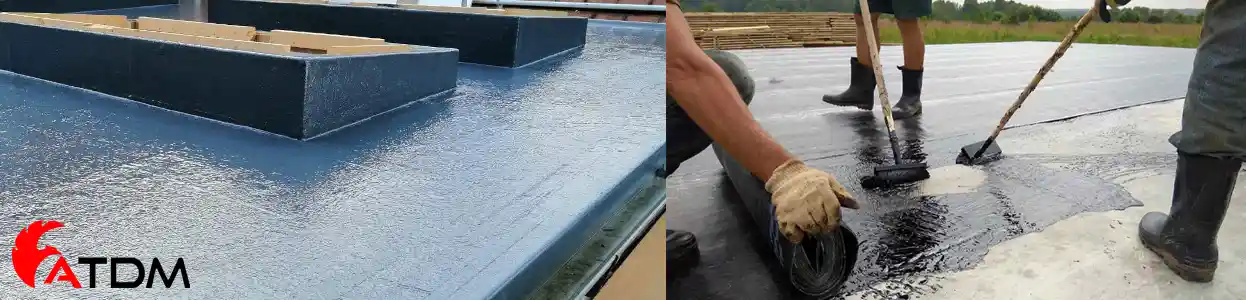
Waterproofing plays a critical role in protecting buildings from moisture damage, structural deterioration, and costly repairs. When comparing bitumen membrane vs liquid waterproofing, the choice often depends on performance, application method, durability, and project requirements. This guide breaks down both systems to help you understand which solution fits your needs best.
What Is Liquid Waterproofing?
Liquid waterproofing uses a fluid-applied coating that cures into a seamless, rubber-like membrane. Contractors apply it with rollers, brushes, or spray equipment. Once it dries, it forms a continuous barrier that resists water penetration.
This system works well on complex surfaces because it adapts easily to irregular shapes, corners, and penetrations. It eliminates joints and seams, which often become weak points in other waterproofing methods.
Table of Contents
ToggleBitumen Membrane vs Liquid Waterproofing: Key Differences
1. Application Method
Bitumen membranes come in pre-formed sheets that installers roll out and bond to surfaces using heat or adhesives. This process requires skill and precision, especially when sealing overlaps and edges.
Liquid waterproofing, on the other hand, applies directly onto the surface. Installers spread or spray the coating, allowing it to cure into a uniform layer. This approach reduces installation complexity and speeds up work on intricate structures.
Verdict: Liquid waterproofing offers easier application, especially for detailed areas.
2. Seamless Protection
Seams often determine the long-term success of any waterproofing system. Bitumen membranes rely on overlapping joints, which can weaken over time if not sealed correctly.
Liquid waterproofing creates a fully seamless layer. It covers every corner, joint, and gap without interruption. This reduces the risk of leaks and improves long-term performance.
Verdict: Liquid waterproofing provides superior seamless coverage.
3. Durability and Lifespan
Both systems deliver strong durability when installed correctly. Bitumen membranes resist mechanical damage and perform well under heavy loads. Many contractors choose them for roofs and foundations that require high impact resistance.
Liquid waterproofing also performs well, especially when reinforced with additional layers or fabrics. However, its lifespan depends heavily on surface preparation and application quality.
Verdict: Bitumen membranes often last longer in high-stress environments.
4. Flexibility and Movement
Buildings expand and contract due to temperature changes and structural movement. Waterproofing systems must adapt to these changes without cracking.
Liquid waterproofing excels in flexibility. It stretches and contracts with the surface, maintaining its integrity over time.
Bitumen membranes also offer flexibility, but seams may limit movement tolerance compared to fully liquid systems.
Verdict: Liquid waterproofing handles structural movement better.
5. Maintenance and Repairs
Repairing bitumen membranes usually involves cutting and replacing damaged sections. This process can take time and may require skilled labor.
Liquid waterproofing allows quick repairs. Contractors can simply reapply the coating over damaged areas, restoring protection without removing large sections.
Verdict: Liquid waterproofing offers easier maintenance.
6. Cost Considerations
Cost plays a major role in selecting between bitumen membrane vs liquid waterproofing.
Bitumen membranes often come with higher upfront material and installation costs due to labor-intensive application. However, their durability can reduce long-term expenses.
Liquid waterproofing typically costs less to install, especially on complex surfaces. However, it may require more frequent maintenance depending on usage and exposure.
Verdict: Liquid waterproofing usually has lower initial costs, while bitumen membranes may offer better long-term value.
Performance of Bitumen Membrane vs Liquid Waterproofing in Different Applications
Roof Waterproofing
Bitumen membranes dominate flat roof applications due to their strength and weather resistance. Many contractors trust them for large-scale roofing projects.
Liquid waterproofing works well for smaller roofs or those with complex designs. It ensures full coverage without gaps.
Basement and Foundation Protection
Both systems perform well in below-ground environments. Bitumen membranes provide strong resistance against water pressure and soil movement.
Liquid waterproofing offers better adaptability for irregular foundation shapes and tight spaces.
Wet Areas (Bathrooms, Balconies)
Liquid waterproofing stands out in wet areas. It easily coats corners, drains, and pipe penetrations, ensuring full protection.
Bitumen membranes may struggle in tight or detailed spaces where precise cutting becomes difficult.
Environmental and Safety Factors
Liquid waterproofing often produces fewer fumes during application, especially when using water-based products. This makes it safer for indoor environments.
Bitumen membrane installation may involve heat application, which requires careful handling and safety precautions.
Both systems now include eco-friendly options, but liquid solutions generally offer a more convenient and safer installation process.
Choosing the Right System between Bitumen Membrane vs Liquid Waterproofing
When deciding between bitumen membrane vs liquid waterproofing, consider the following:
- Choose bitumen membranes for large, flat surfaces that require durability and long-term resistance.
- Choose liquid waterproofing for complex designs, detailed areas, and fast installation.
- Evaluate climate conditions, structural movement, and maintenance expectations.
- Work with reliable suppliers to ensure product quality. For example, ATDM supplies high-quality bitumen membrane solutions for demanding construction projects.
Final Thoughts Bitumen Membrane vs Liquid Waterproofing
The debate between bitumen membrane vs liquid waterproofing comes down to application needs and performance priorities. Bitumen membranes offer proven durability and strength, making them ideal for heavy-duty environments. Liquid waterproofing provides flexibility, seamless coverage, and ease of application, especially for intricate structures.
Both systems deliver excellent waterproofing when applied correctly. The best choice depends on your project’s design, budget, and long-term maintenance goals. By understanding their differences, you can select the solution that ensures maximum protection and lasting performance.