
Barite is a high-density barium sulfate material used to increase fluid weight, stabilize pressure, and protect well integrity in demanding drilling and industrial environments. In real operations, it solves the problem of pressure control without chemically interfering with the system. This material is used by drilling contractors, mud engineers, cementing specialists, and industrial manufacturers who need predictable density and stable performance under load. It matters because consistency, particle control, and purity directly affect safety, equipment life, and operational continuity.
On paper, this mineral looks simple. In practice, it is not.
In the field, performance is judged by how the material behaves during circulation, how evenly it stays suspended, and how little trouble it causes for pumps, screens, and lines. Buyers with experience know that density alone does not guarantee performance. Milling quality, moisture control, and batch consistency matter just as much.
Table of Contents
ToggleATDM treats this product as a process input, not a raw commodity. The goal is stable behavior during long drilling intervals, not just passing a lab test.
API 13A was developed to ensure drilling-grade weighting materials behave reliably under downhole conditions. The standard focuses on density, particle size, and impurity limits because failures in these areas show up fast once drilling starts.
When buyers specify Barite API 13A mesh, they are usually trying to avoid:
Unstable mud weight
Excessive sag in deviated wells
Abrasive damage to equipment
Unexpected chemical contamination
Passing API testing is necessary, but how the material is milled and handled determines how it performs.
Different operations call for different grind profiles:
200 mesh material is widely used in conventional drilling fluids
325 mesh grades are chosen when suspension stability is critical
Custom mesh distributions are used in specialized systems
A common mistake is assuming all API-compliant material behaves the same. In real wells, small differences in particle distribution lead to noticeable performance changes.
The primary application is drilling mud weighting.
In this role, barite increases hydrostatic pressure, supports wellbore stability, and helps prevent formation fluids from entering the well. In extended-reach and horizontal wells, sag control becomes a major concern, and particle quality plays a decisive role.
Poor material leads to density fluctuations and operational delays.
Heavy cement slurries rely on this mineral to achieve target density without sacrificing pumpability. When milling is inconsistent, settling occurs, and cement integrity suffers. Field engineers notice this quickly during placement.
Outside the oilfield, barite is used in:
Paints and protective coatings
Rubber and polymer compounds
Radiation shielding concrete
Friction and brake materials
In these applications, color consistency, fineness, and oil absorption are often more important than drilling standards.
Experienced procurement teams do not buy on price alone. They evaluate:
Required system density
Well geometry and deviation
Sensitivity to sag and settling
Solids tolerance of the system
Supplier consistency over time
Selecting the correct grade of Barite API 13A mesh is about matching material behavior to operating conditions, not simply following past habits.
From real operations, buyers report clear differences:
Well-processed material maintains density with less agitation
Poor milling increases wear on pumps and valves
High moisture content complicates blending accuracy
Inconsistent supply causes unstable rheology
These issues rarely appear in documentation. They appear during circulation.
Even experienced teams make avoidable errors:
Evaluating quality based only on specific gravity
Ignoring long-term batch consistency
Overlooking storage and moisture exposure
Treating suppliers as interchangeable
These mistakes usually surface under operational pressure.
Keep material in dry, covered facilities
Avoid direct contact with ground surfaces
Protect from humidity and condensation
25 kg paper bags
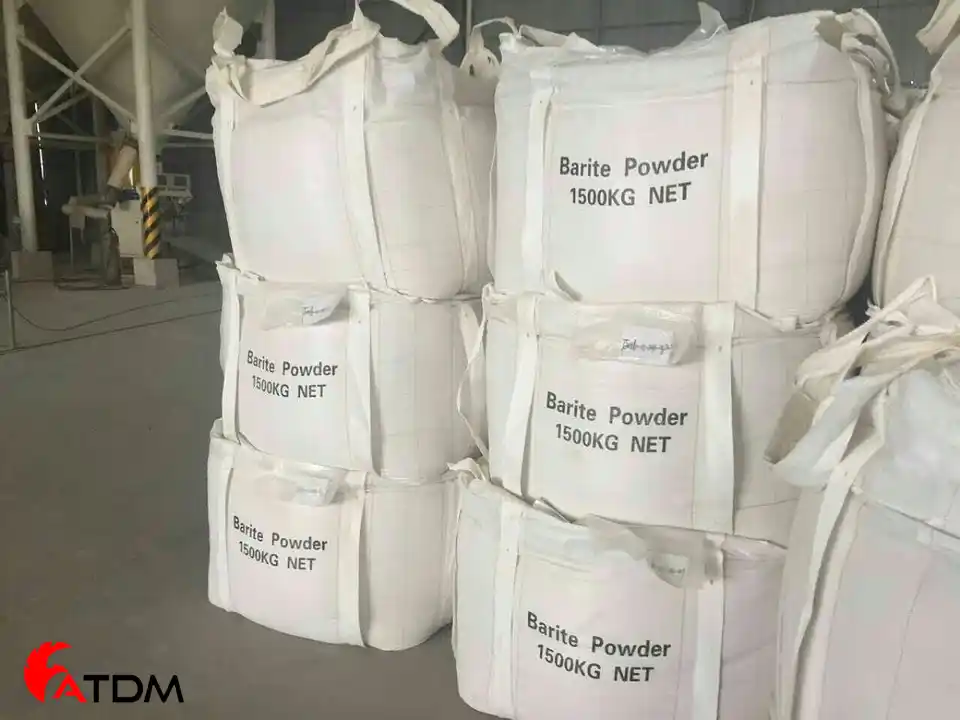
Jumbo bags (1–1.5 MT)
Bulk shipments for large programs
Improper storage leads to clumping, handling delays, and dosing errors.
This material is consumed continuously during drilling campaigns. Any disruption can stop operations that cost tens of thousands per day. For that reason, experienced buyers prioritize suppliers who deliver consistent quality and predictable logistics.
ATDM approaches barite supply as a long-term operational responsibility, not a one-off sale.
Alternatives such as hematite or ilmenite are sometimes evaluated. While they have niche uses, they often introduce higher abrasion, different rheology, and additional system complexity. For most applications, barite remains the most balanced option in terms of availability, cost control, and operational familiarity.
Is this suitable for high-angle wells?
Yes, when particle distribution is properly controlled.
Can mesh size be adjusted?
Yes, depending on milling capability.
Does it react with drilling fluids?
Pure material is chemically inert; impurities cause problems.
What documentation should be supplied?
COA, compliance confirmation, MSDS, and packing details.
Barite is not a product you want to troubleshoot during active operations. When quality is right, it stays unnoticed. When it is wrong, it affects every part of the system.
That is why experienced buyers focus on consistency, control, and supplier reliability, not just specifications.