
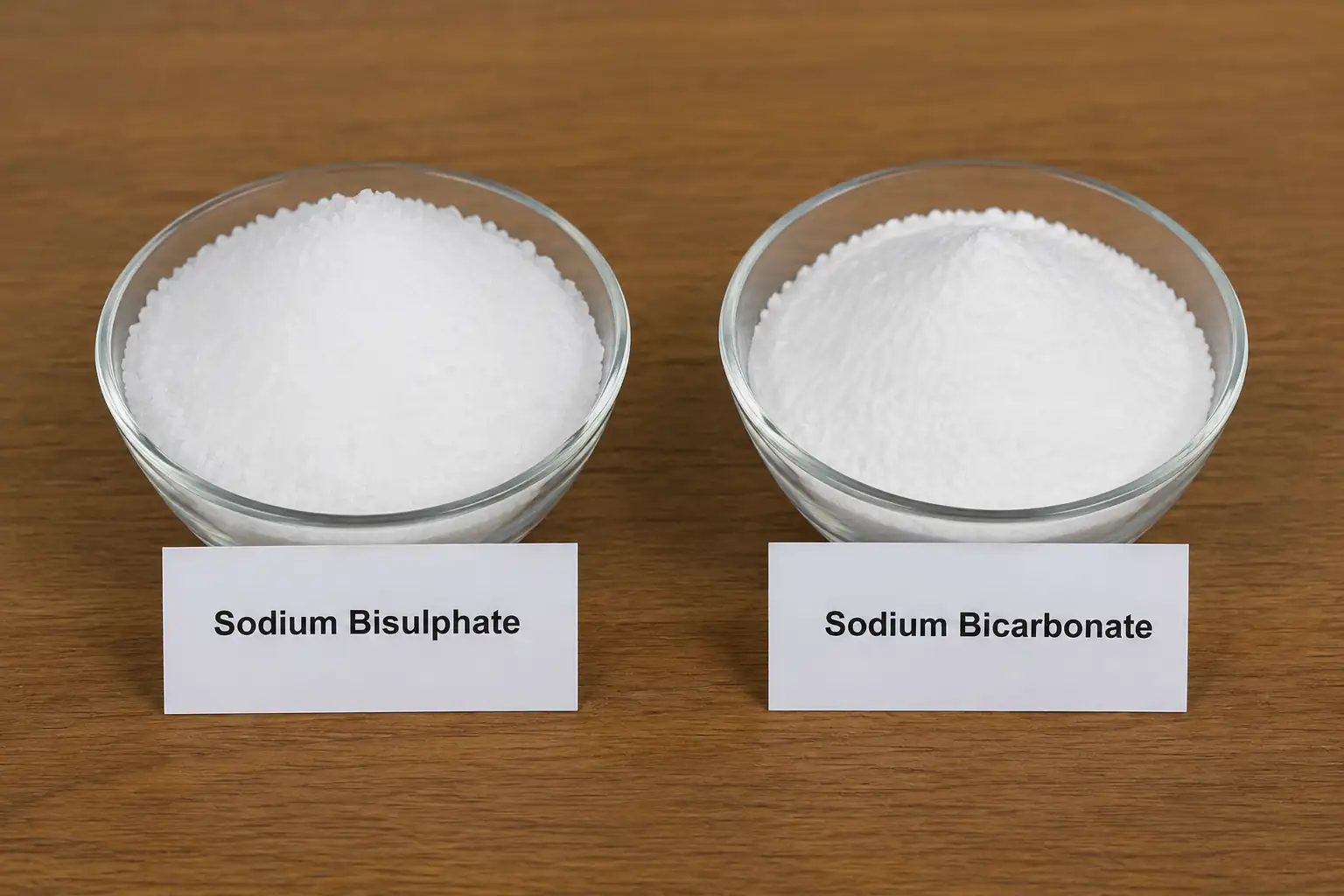
When comparing sodium bisulphate vs sodium bicarbonate, the focus should remain on their differences in chemical composition, behavior, industrial performance, handling requirements, and practical applications rather than explaining each product independently. Although both compounds contain sodium, they perform entirely different functions because of their opposite chemical properties.
Businesses often compare these two chemicals before selecting the right material for manufacturing, water treatment, cleaning, food processing, laboratory work, and industrial production. Choosing the correct compound depends on acidity, alkalinity, reaction characteristics, safety considerations, compatibility with other chemicals, storage conditions, and cost efficiency.
This guide presents a complete side-by-side comparison of sodium bisulphate vs sodium bicarbonate, allowing buyers, engineers, procurement teams, and manufacturers to evaluate both compounds objectively.
Table of Contents
ToggleQuick Comparison Table of Sodium Bisulphate vs Sodium Bicarbonate
| Property | Sodium Bisulphate | Sodium Bicarbonate |
|---|---|---|
| Chemical Formula | NaHSO₄ | NaHCO₃ |
| Chemical Nature | Acidic salt | Alkaline salt |
| pH in Solution | Low (Acidic) | Mildly alkaline |
| Appearance | White crystalline powder | White crystalline powder |
| Odor | Odorless | Odorless |
| Water Solubility | High | Moderate to high |
| Main Function | Reduces pH | Increases or buffers pH |
| Reactivity | Reacts with alkalis | Reacts with acids |
| Heat Stability | Decomposes at high temperatures | Releases CO₂ when heated |
| Corrosiveness | Higher | Very low |
| Food Grade Availability | Limited applications | Widely available |
| Industrial Usage | High | Very high |
| Environmental Impact | Requires controlled disposal | Generally lower impact |
Chemical Composition Comparison
The first difference in sodium bisulphate vs sodium bicarbonate appears in their chemical structures.
Sodium bisulphate contains one sodium ion attached to a hydrogen sulfate ion. The hydrogen atom gives the compound acidic properties, making it effective for lowering pH.
Sodium bicarbonate contains one sodium ion combined with a bicarbonate ion. The bicarbonate group gives the compound mild alkaline properties, allowing it to neutralize acids and stabilize pH.
Although both compounds contain sodium, their accompanying ions completely change their chemical behavior.
Acidity vs Alkalinity
One of the most significant distinctions between sodium bisulphate vs sodium bicarbonate involves pH control.
Sodium bisulphate acts as an acidifying agent. It lowers the pH of solutions and increases acidity. Industries use it whenever a process requires controlled acidification.
Sodium bicarbonate works in the opposite direction. It neutralizes acids and raises pH slightly while acting as a buffering agent.
| Feature | Sodium Bisulphate | Sodium Bicarbonate |
|---|---|---|
| Acidic | Yes | No |
| Alkaline | No | Yes |
| pH Reduction | Excellent | No |
| pH Increase | No | Moderate |
| Buffering Ability | Limited | Excellent |
Physical Characteristics of Sodium Bisulphate vs Sodium Bicarbonate
Although both compounds appear similar at first glance, they differ in several physical characteristics.
| Characteristic | Sodium Bisulphate | Sodium Bicarbonate |
|---|---|---|
| Color | White | White |
| Crystal Form | Granular or crystalline | Fine crystalline powder |
| Density | Higher | Lower |
| Moisture Sensitivity | Moderate | Low |
| Flowability | Good | Excellent |
Both chemicals remain odorless and easy to transport, but sodium bicarbonate generally produces less dust during handling.
Water Solubility Comparison
Water solubility directly affects industrial performance.
Sodium bisulphate dissolves rapidly in water while producing an acidic solution.
Sodium bicarbonate also dissolves well but creates a mildly alkaline solution.
Neither compound requires special solvents under normal operating conditions.
Chemical Reactivity
Chemical reactions represent another major difference in sodium bisulphate vs sodium bicarbonate.
Sodium Bisulphate
Reacts with alkaline materials
Produces acidic conditions
Supports acid-based industrial reactions
Reacts with carbonates and bicarbonates
Sodium Bicarbonate
Neutralizes acids
Produces carbon dioxide during acid reactions
Acts as a buffering compound
Maintains stable pH levels
These opposite reaction mechanisms determine where each chemical performs best.
Industrial Performance of Sodium Bisulphate vs Sodium Bicarbonate
Many industries compare sodium bisulphate vs sodium bicarbonate based on process efficiency.
| Industrial Requirement | Better Choice |
|---|---|
| Lowering pH | Sodium Bisulphate |
| Neutralizing Acid | Sodium Bicarbonate |
| Buffering Solutions | Sodium Bicarbonate |
| Acid Cleaning | Sodium Bisulphate |
| Mild Cleaning | Sodium Bicarbonate |
| Controlled Acidification | Sodium Bisulphate |
| Laboratory Buffer Systems | Sodium Bicarbonate |
Industrial engineers usually select the compound according to the desired chemical reaction instead of cost alone.
Safety Comparison
Safety remains an essential factor when comparing chemicals.
| Safety Factor | Sodium Bisulphate | Sodium Bicarbonate |
|---|---|---|
| Skin Irritation | Moderate | Low |
| Eye Irritation | High | Mild |
| Respiratory Risk | Moderate | Low |
| Protective Equipment | Recommended | Basic protection |
| Handling Difficulty | Moderate | Easy |
Sodium bicarbonate generally requires fewer handling precautions because of its lower reactivity.
Storage Requirements
Proper storage extends product quality and minimizes contamination.
Sodium Bisulphate
Store in a dry environment
Protect from moisture
Keep away from alkaline substances
Use corrosion-resistant containers
Sodium Bicarbonate
Store in sealed containers
Protect from excessive humidity
Avoid strong acids
Maintain clean storage conditions
Both materials benefit from cool, dry storage with proper ventilation.
Transportation Comparison
Transportation requirements also differ.
| Feature | Sodium Bisulphate | Sodium Bicarbonate |
|---|---|---|
| Moisture Protection | Essential | Recommended |
| Corrosion Risk | Moderate | Minimal |
| Packaging Strength | High | Standard |
| Transport Stability | Good | Excellent |
Environmental Considerations
Environmental performance often influences purchasing decisions.
Sodium bicarbonate usually presents fewer environmental concerns because of its mild alkalinity and lower hazard profile.
Sodium bisulphate requires more controlled disposal due to its acidic nature. Users should always follow local environmental regulations when handling waste streams.
Proper storage and responsible disposal reduce environmental impact for both materials.
Cost Comparison
Pricing varies according to purity, production method, packaging, and market conditions.
| Cost Factor | Sodium Bisulphate | Sodium Bicarbonate |
|---|---|---|
| Production Cost | Moderate | Moderate |
| Transportation Cost | Similar | Similar |
| Storage Cost | Slightly Higher | Lower |
| Handling Cost | Higher | Lower |
| Maintenance Cost | Higher | Lower |
The total operating cost often depends more on application requirements than the purchase price alone.
Compatibility Comparison
Compatibility plays a major role in industrial systems.
Sodium Bisulphate
Compatible with:
Acid-resistant materials
Water treatment systems
Certain cleaning formulations
Avoid mixing with:
Strong alkalis
Reactive metals
Incompatible oxidizers
Sodium Bicarbonate
Compatible with:
Mild cleaning formulations
Food processing systems
Pharmaceutical processes
Laboratory applications
Avoid mixing with:
Strong acids
Concentrated acidic solutions
Performance Summary
The following table provides a direct overview of sodium bisulphate vs sodium bicarbonate.
| Comparison Factor | Sodium Bisulphate | Sodium Bicarbonate |
|---|---|---|
| Acidic Strength | High | None |
| Alkalinity | None | Mild |
| Buffer Capacity | Low | High |
| Neutralization Ability | Low | Excellent |
| Corrosiveness | Higher | Low |
| Safety | Moderate | High |
| Handling Ease | Moderate | Easy |
| Storage Stability | Good | Excellent |
| Environmental Friendliness | Moderate | High |
| Industrial Versatility | High | Very High |
Which Chemical Fits Different Industrial Requirements?
Selecting between sodium bisulphate vs sodium bicarbonate depends entirely on the intended industrial objective.
When a process requires lowering pH, promoting acidic reactions, or improving acid-based cleaning efficiency, sodium bisulphate offers the better solution.
When a process requires neutralizing acids, buffering solutions, stabilizing pH, or minimizing handling risks, sodium bicarbonate becomes the preferred option.
Neither chemical replaces the other because their chemical behavior differs fundamentally. Instead, they complement different industrial processes by delivering opposite chemical effects.
For procurement teams, purchasing decisions should consider process compatibility, operational safety, storage conditions, transportation requirements, and overall lifecycle costs rather than focusing on price alone.
Reliable sourcing also contributes to consistent product quality and uninterrupted production. ATDM supplies industrial chemicals with a strong focus on quality, dependable supply, and customer support, helping manufacturers obtain materials that meet demanding operational standards.
Conclusion: Sodium Bisulphate vs Sodium Bicarbonate
The comparison of sodium bisulphate vs sodium bicarbonate clearly shows that these compounds serve different purposes despite their similar appearance and sodium content. Sodium bisulphate functions as an acidic compound that lowers pH and supports acid-driven industrial processes, while sodium bicarbonate acts as a mild alkaline material that neutralizes acids and stabilizes pH.
Their differences extend beyond acidity and alkalinity to include chemical reactivity, safety, storage, transportation, environmental considerations, and operational performance. Understanding these distinctions enables manufacturers, laboratories, water treatment facilities, and industrial buyers to select the most suitable material for their specific applications.
Partnering with a trusted supplier is equally important when purchasing industrial chemicals. ATDM provides dependable sourcing solutions and consistent product quality, allowing businesses to maintain efficient operations while meeting industry standards and performance expectations.