
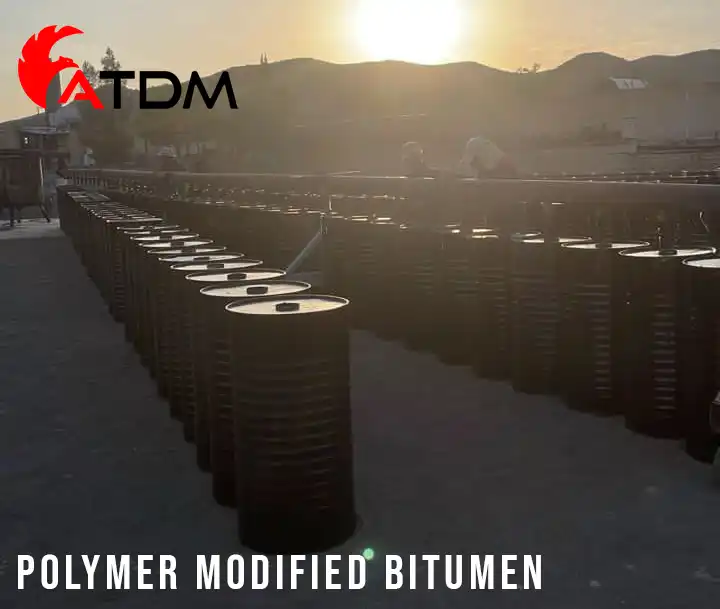
When builders want roads that stay flexible in winter, stay strong in summer, and survive heavy traffic, they choose Polymer Modified Bitumen (PMB). At the same time, many contractors trust ATDM as a leading supplier of bitumen and PMB from Iran and the UAE because they need consistent quality in every shipment. PMB delivers better durability, smoother pavements, and longer service life compared to normal bitumen, which makes it a premium choice for modern infrastructure.
Polymer Modified Bitumen is a form of bitumen enhanced with special polymers like SBS, EVA, or crumb rubber. Because of these additives, the binder becomes more elastic, stronger, and more resistant to cracks.
In simple words, PMB is normal bitumen upgraded to a stronger level. Although standard bitumen works for many roads, PMB works even better in tough conditions where traffic is heavy or climate changes rapidly.
Table of Contents
TogglePMB is popular in road construction because it solves the common problems of standard bitumen. It offers:
Higher elasticity, so the pavement can stretch without cracking
Better resistance to rutting, especially during hot summers
Improved aging and oxidation resistance
Better bonding with aggregates
Higher durability under heavy loads
Smooth and long-lasting asphalt surfaces
Moreover, PMB reduces maintenance costs over time. Even though it costs slightly more than regular bitumen, it saves money in the long term because roads remain stronger and smoother.
Because PMB improves both flexibility and stiffness, it works extremely well in both hot and cold climates.
In Hot Climates
Prevents softening
Reduces pavement deformation
Controls rutting under truck traffic
In Cold Climates
Prevents cracking
Maintains elasticity
Handles freeze–thaw cycles smoothly
Consequently, countries with extreme temperatures rely heavily on PMB for highways, airports, and industrial roads.
PMB performance depends on the polymer type. The most common ones include:
1. SBS (Styrene-Butadiene-Styrene)
Most used
Gives high elasticity
Provides strong crack resistance
2. EVA (Ethylene Vinyl Acetate)
Improves stiffness
Works well in hot climates
3. Crumb Rubber (CRMB)
Made from recycled tires
Environment-friendly
Enhances flexibility and skid resistance
Because each polymer improves the binder in a different way, PMB can be customized to match specific project needs.
PMB is widely used in projects where long life and high performance are essential.
Highway Construction
Because highways carry heavy trucks daily, PMB prevents rutting and keeps the asphalt smooth.
Airport Runways
PMB performs extremely well under high pressure and heat generated by airplane tires.
Industrial Areas
It works perfectly for heavy-duty pavements, storage yards, and port zones.
Bridges and Tunnels
Because PMB handles vibration and temperature changes, it is ideal for bridges.
City Roads & Roundabouts
It increases skid resistance, which improves safety for drivers.
✔ More Durable
The polymer structure makes PMB stronger against aging and oxidation.
✔ Reduced Cracks and Deformation
Its high elasticity prevents both low-temperature cracks and high-temperature rutting.
✔ Better Water Resistance
PMB tightly bonds with aggregates, reducing water penetration.
✔ Longer Road Life
Because of its performance, PMB roads last much longer than normal bitumen roads.
✔ Cost Effective
Even though the initial cost is higher, the long-term savings are huge because maintenance becomes less frequent.
PMB production involves mixing bitumen with polymers at controlled temperatures using high-shear mixers. The process includes:
Heating base bitumen
Adding polymer in controlled batches
Continuous mixing for proper dispersion
Stabilizing and homogenizing the mixture
Testing viscosity, elasticity, penetration, and softening point
Because of strict production steps, PMB must be supplied by experienced companies to ensure consistent quality.
ATDM and other suppliers typically provide PMB in:
Steel drums
Poly bags or meltable PE bags
Bulk tankers
Jumbo bags (for solid modified bitumen)
These options help buyers choose the most suitable and cost-effective packaging for their project or country regulations.
Even though PMB is safe, it must be handled correctly:
Always heat within recommended temperature limits
Wear protective gloves and goggles
Avoid direct contact with hot material
Ensure proper ventilation when heating
Following these steps greatly reduces risks during production and road construction.
1. What makes Polymer Modified Bitumen better than normal bitumen?
PMB performs better because polymers add elasticity and strength. Therefore, the asphalt resists cracking, rutting, and aging much more effectively than standard bitumen.
2. Where is Polymer Modified Bitumen most commonly used?
PMB is mainly used in highways, airports, industrial zones, bridges, and any project that needs high durability and stability under extreme conditions.
3. Does PMB reduce road maintenance costs?
Yes. Because PMB lasts longer and handles stress better, it significantly reduces repairs and long-term maintenance costs, making it a smart investment for large infrastructure.
Polymer Modified Bitumen is one of the most advanced materials for modern road construction, offering better performance, longer life, and safer pavements. Because it combines strength, elasticity, and high-temperature resistance, it has become a top choice for infrastructure engineers worldwide. If you want a reliable supplier for PMB or any type of bitumen, ATDM provides high-quality products from Iran and the UAE with global delivery options, ensuring your project gets the performance it deserves.