
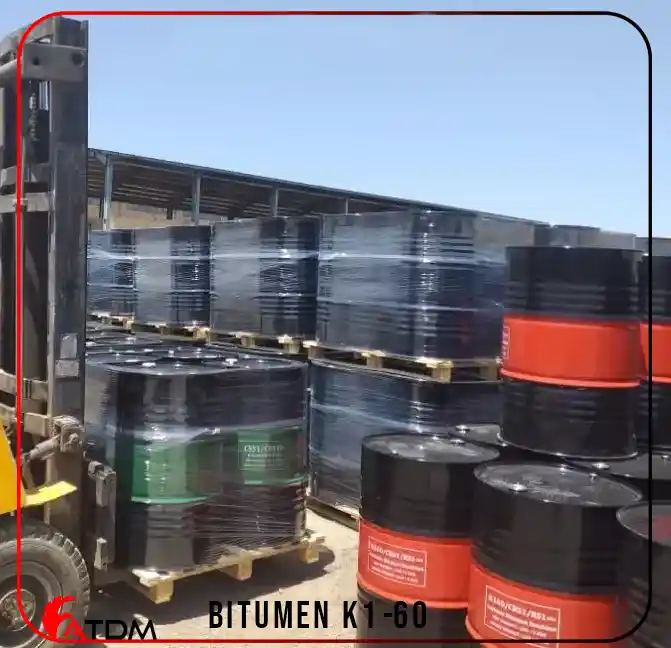
When speed, safety, and strong adhesion matter, Bitumen K 160 becomes a smart solution. This product is a cationic bitumen emulsion, specially engineered for efficient application in pavement works. Unlike conventional hot bitumen, it is supplied in liquid form at ambient temperature. That means easier handling, lower energy consumption, and faster execution on site.
In today’s asphalt industry, contractors look for materials that combine performance with practicality. Bitumen K1-60 delivers both. It offers excellent bonding to aggregates, smooth sprayability, and reliable curing behavior. Whether for tack coating, surface dressing, or maintenance projects, this grade helps teams work faster and safer.
Let’s explore everything you need to know about this emulsion grade bitumen — from technical behavior to pricing insights.
Table of Contents
ToggleBitumen K1-60 is a cationic rapid-setting emulsion. It consists of bitumen particles dispersed in water with the help of emulsifying agents. Because it is cationic, the bitumen droplets carry a positive charge. This allows strong attraction to negatively charged aggregates such as granite and limestone.
Unlike penetration grades that require heating to 150–170°C, Bitumen K1-60 can be applied at much lower temperatures. This reduces fuel costs and lowers environmental impact.
The “160” classification refers to its viscosity and breaking characteristics, making it suitable for spray applications where controlled setting time is essential.
There are several reasons why this emulsion grade is widely used in asphalt maintenance and construction:
No need for high-temperature heating
Reduced fire and burn risks
Easy pumping and spraying
Strong adhesion to dusty or slightly moist aggregates
Faster site progress
Because it is water-based, the material spreads evenly and penetrates well into base layers. After application, the water evaporates and leaves behind a durable bitumen film.
For contractors working in road constraction projects where time and safety are priorities, this grade offers real operational advantages.
Understanding Bitumen K 160 uses helps project managers choose the right grade for the right job. Common applications include:
Applied between asphalt layers to improve bonding strength.
Used on granular bases before asphalt overlay.
Ensures aggregate chips stick firmly to the pavement.
Ideal for maintenance works where heating facilities are limited.
Because of its rapid setting properties, it minimizes traffic disruption and shortens curing time.
Bitumen K 160 stands out due to:
Excellent coating ability
Strong adhesion to aggregates
Quick breaking after application
Uniform spray pattern
Controlled viscosity
These characteristics make it reliable in both small municipal projects and large-scale highway developments.
When compared with other emulsions like Bitumen SS1, K 160 generally provides faster setting and stronger early bonding, especially in warm climates.
Contractors often search for a Bitumen K1-60 equivalent in different markets. Depending on national standards, it may correspond to:
Cationic Rapid Setting (CRS) emulsions
Certain RS-1 or CRS-1 grades under ASTM
Specific EN-standard rapid setting emulsions
However, exact equivalency depends on viscosity, residue content, and breaking time. Always compare technical data sheets before substitution.
Although exact values vary by refinery and production batch, typical characteristics include:
Residue by evaporation: Approx. 60%
Viscosity (Saybolt Furol): Controlled spray range
Particle charge: Positive (Cationic)
Setting behavior: Rapid
Storage stability: Stable under recommended conditions
For precise technical data, suppliers provide full TDS and laboratory results for each shipment.
Bitumen K 160 should be stored in clean, sealed tanks. Recommended storage temperature is usually between 5°C and 50°C.
Key handling tips:
Avoid contamination with other chemicals
Stir gently before use if stored long
Protect from freezing
Do not overheat
Since it is water-based, freezing can damage the emulsion structure.
One major advantage of emulsion grades is environmental performance. Compared to traditional hot bitumen:
Lower CO₂ emissions
Reduced fuel consumption
Safer working environment
Less smoke and odor
These benefits align with modern sustainability goals in infrastructure projects.
The Bitumen K 160 price depends on multiple factors:
Crude oil fluctuations
Bitumen content percentage
Emulsifier cost
Packaging type
Order volume
Freight distance
Market demand also influences seasonal pricing. Contractors typically compare it with overall bitumen price trends to decide procurement timing.
For export shipments, buyers often request the Bitumen FOB price to understand base material cost before freight and insurance.
The broader Cationic Bitumen Emulsion price market is influenced by:
Global crude benchmarks
Regional refinery output
Infrastructure investments
Currency exchange rates
Bulk orders usually receive better rates. Packaging in bulk tankers tends to be more cost-efficient than drums.
If you are searching for Bitumen K 160 for sale, it is important to choose an experienced supplier. Quality control, consistent formulation, and export documentation matter just as much as price.
ATDM is recognized as a reliable supplier of emulsion and penetration grade bitumen for international markets. The company ensures:
Strict quality inspection before loading
Standardized production
Export-ready packaging
Professional logistics coordination
With proper documentation and laboratory testing, buyers receive transparent product data and shipment tracking.
ATDM supports clients across multiple regions, offering both bulk and drum packaging solutions.
Bitumen K 160 is typically supplied in:
200 kg steel drums
1 MT IBC tanks
Bulk tanker trucks
ISO tanks for export
Packaging choice depends on project size and transport method.
To achieve optimal performance:
Ensure surface is clean and dust-free
Apply evenly using calibrated sprayers
Avoid application during heavy rain
Allow proper breaking and curing time
Maintain recommended spray rate
Correct application ensures strong bonding and longer pavement life.
Compared to slower-setting emulsions, K 160 provides:
Faster curing
Stronger initial bond
Better performance in warm weather
However, project conditions determine the best choice. Always consult technical experts before final selection.
Each batch typically undergoes:
Residue content testing
Viscosity measurement
Settlement evaluation
Storage stability checks
Sieve test
Quality assurance ensures consistent performance from production to site.
Infrastructure development continues to grow globally. Maintenance of existing roads is also increasing. This trend boosts demand for emulsion grades like K 160.
Governments and contractors favor emulsions due to:
Reduced environmental impact
Lower project cost
Improved worker safety
As sustainability standards tighten, emulsion usage is expected to expand further.
Bitumen quality directly affects pavement durability. Poor emulsion stability can cause:
Weak bonding
Premature cracking
Surface failure
Working with established exporters ensures consistent formulation and reliable shipment.
ATDM provides verified test reports and technical support, helping contractors avoid costly project delays.
Bitumen K 160 is more than just an emulsion. It is a modern solution designed for efficiency, safety, and performance. Its rapid-setting properties, strong adhesion, and easy application make it ideal for maintenance and construction projects.
From understanding Bitumen K 160 uses to evaluating Bitumen K 160 price trends, selecting the right grade plays a critical role in project success. Whether for domestic infrastructure or international export, this emulsion grade continues to prove its value.
If you are planning a road project and need dependable material with strong performance, Bitumen K 160 offers a balanced combination of practicality and durability.